






Limcaoco is ING-FINEX CFO of the Year

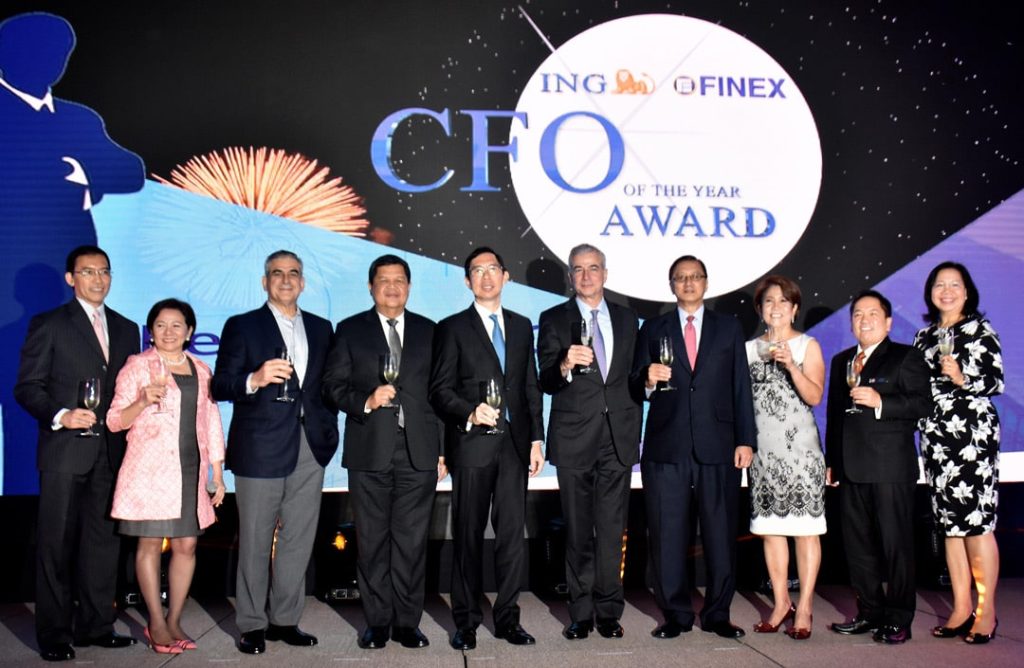
The Financial Executives Institute of the Philippines and ING Bank NV have named Ayala Corporation Chief Finance Officer Jose Teodoro K. Limcaoco as this year’s CFO of the Year.

As CFO of Ayala, Limcaoco is tasked to manage P900 billion in assets of the Philippines’ oldest and largest conglomerate which has diverse interests in real estate, financial services, telecommunications, water infrastructure, electronics manufacturing, power generation, transport, automotive, healthcare, and education.

“TG plays a very important role in the growth of Ayala Corp. He has a wide lens in which he views things. Our conversations stretch beyond the financials and encompass what we want Ayala to become,” says Ayala Chairman and CEO Jaime Augusto Zobel de Ayala.

JAZA credits Limcaoco for remodeling the capital allocation process at the parent company. This year, Limcaoco spearheaded the issuance of a $400-million “fixed-for-life” perpetual bond offering to help fund the conglomerate’s long-term investments; it was the Philippines’ first international corporate issuance in 2017 and also signaled Ayala’s return to the offshore debt market after a long hiatus. Moreover, in his concurrent roles as Chief Risk Officer and Chief Sustainability Officer of Ayala, Limcaoco has heightened the parent company’s focus on risk management and the group’s alignment to the United Nations Sustainable Development Goals.

Accepting his award on November 20, Limcaoco said: “The role of the CFO is constantly changing, for finance is the lifeblood and tangible measure of corporate success. As corporations and businesses evolve to be more responsible to all their stakeholders, so, too, will the responsibility of a CFO evolve to address and ensure the long-term sustainability of his or her business. This is the challenge we all face and must prepare our successors to address.”

Limcaoco is the fifth Ayala group CFO to receive the organization’s highest distinction, previously won by Ayala Land’s Jaime Ysmael (2011), Manila Water’s Sherisa Nuesa (2008) and Luis Juan Oreta (2015), and Globe’s Delfin Gonzalez Jr. (2007), who was later appointed Ayala CFO.

Limcaoco-is-ING-FINEX-CFO-of-the-Year
Ayala Corporation Chief Finance Officer Jose Teodoro “TG” Limcaoco is honored as the 11th ING-FINEX CFO of the Year by (from left) ING Bank Country Manager Hans Sicat, FINEX President Benedicta Du-Baladad, Ayala Chairman and CEO Jaime Augusto Zobel de Ayala, Bangko Sentral ng Pilipinas Governor Nestor Espenilla Jr., Ayala President and COO Fernando Zobel de Ayala, Chairman of the Board of Judges Edmundo Soriano, former ING Bank Country Manager Consuelo Garcia, FINEX Liaison Director Cecilio Paul San Pedro, and Chair of the 2017 Awards Committee Judith Lopez

Find out more about ING-FINEX CFO of the Year, TG Limcaoco in this video:

AC Energy, Kennedy Renewable light up MSU Tawi-Tawi’s best and brightest

Ayala’s latest social venture brings the benefits of solar energy to one of the most far-flung islands of the Philippines

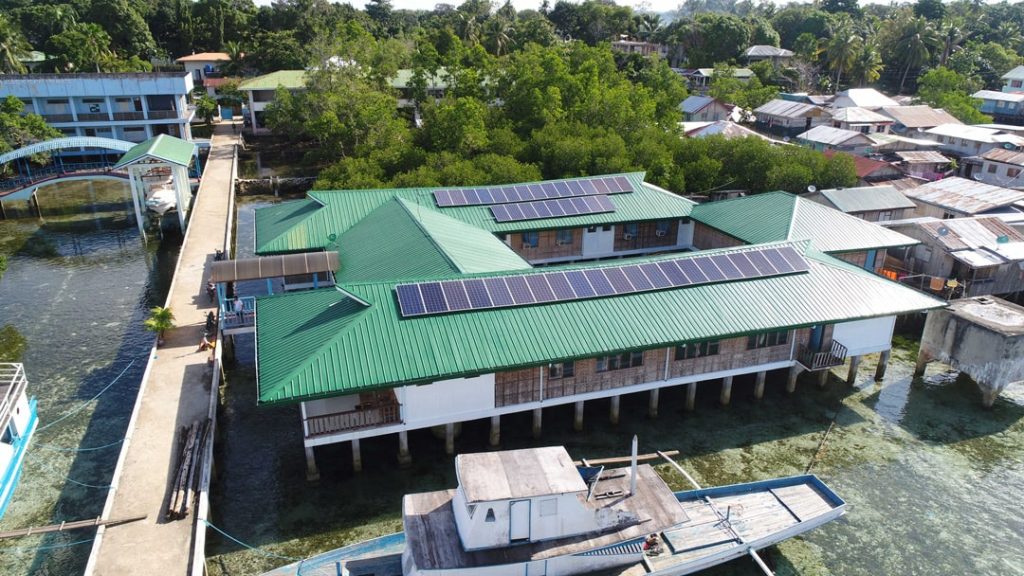
TAWI-TAWI – Far from commercial grids and power lines, the island of Tawi-Tawi sits at the southernmost part of the Philippines. In this remote province, only 30% of the population has access to electricity, which is predominantly sourced from diesel generators. Due to the unstable electric supply, the island experiences rolling blackouts that stunt progress and slow down the delivery of essential services, such as health and education. For the Mindanao State University (MSU) in Bongao, Tawi-Tawi—whose vision is to be a center of excellence in Fisheries, Marine and Maritime Science and Engineering, and Oceanography— this means that the quality of their educational program is undermined and that the productivity of their students is often disrupted.


AC-Energy-Kennedy-Renewable-light-up-MSU-Tawi-Tawis-best-and-brightest

Working with MSU, AC Energy has partnered with Kennedy Renewable + Technology Corp. to address the power shortage and provide the school with solar panels. AC Energy, whose recent focus in the development of renewable energy, provided technical and financial support, with Kennedy acting as the main developer and engineering, procurement, and construction (EPC) contractor for the project. Seven campus buildings were outfitted with solar panels, hybrid inverters and batteries, providing not only 141kW capacity to the university, but also energy storage capability. The system works in tandem with the local power supply, thereby reducing the impact of electrical disruptions and lowering the school’s cost of electricity. 


“The successful launch of this project highlights the reality of conglomerates successfully working with small companies that labor under challenging circumstances to promote sustainable development. This installation is a living, although modest, testament of how organizations like AC Energy and Kennedy Renewable + Technology Corp. solve real problems of power shortages that affect critical institutions in remote areas. Many more projects like this will help advance the cause of energy derived from sources that are replenished by nature,” said Dr. Philip Ella Juico, Chairman of Kennedy Renewable + Technology Corp.


AC-Energy-Kennedy-Renewable-light-up-MSU-Tawi-Tawis-best-and-brightest-2

This renewable source of power enhances MSU’s role, as the only university in the province, in providing quality education despite the inefficiencies in the current local power situation. In these far-flung areas, access to electricity is directly linked to access to education. As the island’s sole institution for higher education, MSU Tawi-Tawi is now closer to its goal of producing experts in fisheries and agriculture, which are key drivers of their local industry. AC Energy’s President & CEO, Eric T. Francia added “Our company sees great value in not only providing electricity to far-flung regions of our country, but also to critical institutions of growth like MSU. Partnering with Kennedy Renewable and MSU to stabilize their campus’ power supply directly impacts the quality of education that the school’s students will receive. We are excited about the possibilities energy can provide—especially to the education of our future generation.” 


###

AC Energy is one of the fastest growing businesses of Ayala Corporation with more than US$ 1 billion of invested and committed capital, with investments in renewable energy and conventional power.

AC Energy is positioned to exceed 2,000 MW of attributable generation capacity and scale up its renewable energy portfolio to over 1,000 MW by 2020.

AC Energy is expanding beyond the Philippines and expected to grow its presence in Indonesia and other Southeast Asian markets.  


For inquiries and more information, please contact:

Irene Maranan

Head – Corporate Marketing and Sustainability

AC Energy


Email :  maranan.is@acenergy.com.ph

Contact number:  0917.5298339 or 908.3373

Website:  www.acenergy.com.ph

Ayala’s nine-month net income reaches ₱23.2 billion, up 18 percent from a year ago

Ayala Corporation sustained its earnings momentum in the first nine months of the year, with net income reaching ₱23.2 billion, an 18 percent-growth from its year-ago level. This was bolstered by the strong performance of its real estate unit, and boosted by the continued ramp-up of its power business. 

In the third quarter, Ayala’s net income jumped 39 percent year-on-year to ₱8.2 billion, driven by robust earnings from Ayala Land, Bank of the Philippine Islands, and AC Energy. This was lifted by transaction gains realized by Globe Telecom from the investment of Ant Financial in its fintech unit Mynt. Moreover, the income realized by AC Energy from services that enabled the financial close and construction of a power plant lifted Ayala’s net earnings in the third quarter. Isolating these transaction gains, Ayala’s third quarter net income grew 26 percent from a year ago. 

“Most of our business units have continued to achieve solid growth this year,” Ayala President and  Chief Operating Officer Fernando Zobel de Ayala said. “We are pleased to note that even excluding the transaction gains from various strategic initiatives for the period, Ayala’s ninemonth net income still expanded 18 percent from the previous year,” Mr. Zobel said.


Real Estate

The sustained performance of the residential segment, office-for-sale, and commercial leasing businesses drove the 18 percent growth in Ayala Land’s nine-month net income to ₱17.8 billion.

In property development, residential revenues jumped 30 percent from its year-ago level to ₱57.3 billion driven by new bookings and project completions led by the Alveo and Avida brands. Reservation sales in the first nine months amounted to ₱94.2 billion, 12 percent higher year-onyear, with average monthly sales amounting to ₱10.5 billion. Unbooked revenues from reservation sales reached its highest level to date at ₱141 billion from ₱127 billion in end-2016, while net booked sales for the period climbed 16 percent to ₱66.9 billion.

Office-for-sale revenues surged 50 percent year-on-year to ₱6.3 billion bolstered by sales from the High Street South Corporate Plaza 2 project. In the commercial and industrial lots segment, Ayala Land posted ₱4.8 billion revenues in the first nine months, up 8 percent from a year ago, fueled by strong lot sales in Arca South, Vermosa, and Naic, Cavite.

During the period, Ayala Land launched ₱53.9 billion worth of residential and office-for-sale projects.

In commercial leasing, shopping center revenues reached ₱11.8 billion, 11 percent higher than the previous year backed by contributions from new malls. Office leasing revenues grew 11 percent to ₱4.5 billion, lifted by stabilized occupancy of UP Town Center, Ebloc 4, and Alabang Town Center BPO offices. Moreover, hotel and resorts revenues were steady at ₱4.8 billion, up six percent year-on-year, driven by higher occupancy and average room rates of El Nido Resorts. Property management revenues climbed 51 percent to ₱1.6 billion supported by increase in managed properties. These recurring income businesses contributed 35 percent of Ayala Land’s net income during the period.


Banking

In banking, the sustained momentum of Bank of the Philippine Islands’ core banking and feebased businesses cushioned the absence of significant gains from a capital exercise in the previous year. The bank posted ₱17 billion in net income in the first nine months, 1.9 percent lower yearon-year

The bank’s total revenues rose five percent to ₱53 billion as net interest income rose 13.5 percent to ₱35.5 billion driven by higher asset yields and expansion of its average asset base. Non-interest income fell to ₱17.5 billion, down 8.4 percent from a year ago, due to the absence of significant one-off securities trading gains similar to those realized in June 2016. The lower trading gains was partially offset by the bank’s fee-based income, which rose 20.1 percent during the period backed by credit card, investment banking, and trust fees. BPI’s cost-to-income ratio increased to 52.5 percent as the bank continues to invest in new technology to improve operating efficiencies.

BPI’s loan book expanded 21 percent as of end-September 2017 to ₱1.1 trillion compared to the same period a year ago, supported by a 24 percent-growth in corporate loans. The corporate segment accounted for 80 percent, while the consumer segment comprised 20 percent of the bank’s loan portfolio. BPI maintained its asset quality with a 90-day non-performing loans ratio of 1.5 percent and a 126 percent reserve cover. Total deposits in the first nine months of the year stood at ₱1.5 trillion, 14 percent higher than a year ago, with its current and savings account ratio at 71 percent.


Telecom

Continued demand for data-related services, lifted by a ₱1.9 billion gain from the strategic partnership forged by Mynt, drove Globe Telecom’s net income to ₱13 billion, 11 percent higher than a year ago. This one-time gain pared Globe’s share in equity losses and amortization charges related to the acquisition of San Miguel’s telco assets, higher interest expenses, and depreciation.

Globe’s gross service revenues improved six percent to ₱95.1 billion led by a broad-based growth across its mobile, home broadband and corporate data segments. Mobile revenues grew 7 Ayala Corporation | 9M 2017 Earnings Release 3 | P a g e November 10, 2017 percent to ₱73.1 billion, driven by sustained high demand for mobile data. Mobile data revenues increased 20 percent to ₱31.3 billion as mobile data traffic soared 73 percent to 430 petabytes in the first nine months of the year.

Home broadband revenues rose eight percent from its year-ago level to ₱11.7 billion, tracking a nine percent growth in broadband subscribers to 1.3 million. Meanwhile, corporate data revenues ended the period four percent higher to ₱7.6 billion. On a combined basis, Globe’s revenues from data-related services amounted to ₱50.6 billion, up 14 percent year-on-year. Data services accounted for 53 percent of Globe’s gross service revenues in the first nine months compared to 49 percent in the previous year.

Globe posted an earnings before interest, taxes, depreciation and amortization (EBITDA) of ₱40.6 billion, up eight percent from the previous year, backed by strong revenues despite higher operating expenses. Moreover, EBITDA margin improved to 43 percent from its year-ago level of 42 percent.

Without the impact of the gains from the increase in fair value of its retained equity interest in Mynt and the costs related to the acquisition of San Miguel’s telecom assets, Globe’s net earnings dropped 2 percent year-on-year owing to higher depreciation expense and interest and financing charges.

As part of its commitment to improve internet services in the country, Globe is deploying US$100 million in additional capital expenditures for the year to fund the expansion of its mobile data network, bringing Globe’s total capital spending plan to US$850 million for 2017. The additional investment will be used to deploy new cell sites that utilize the 700 and 2600 megahertz frequencies aimed at expanding internet capacity and mobile coverage.

In October, with partners Ant Financial and Ayala, Globe launched its digital payment platform through GCash, which utilizes Quick Response (QR) codes for retail merchants. The system allows customers to pay for goods and services using their smartphones. The system was first launched with Ayala Malls and is targeted to expand to other retail outlets.


Water

Manila Water’s nine-month net earnings ended flat from a year ago at ₱4.9 billion, as higher operating costs and expenses from expansion initiatives weighed down its topline growth.

Manila Water’s revenues rose three percent to ₱13.8 billion, in step with a three percent expansion of total billed volume to 554.4 million cubic meters. In the first nine months of the year, the Manila Concession registered ₱4.5 billion in net income, three percent higher than the previous year, supported by a steady growth in billed volume and lower depreciation expenses. Billed volume stood at 366.6 million cubic meters, two percent higher than its year ago level, on the back of higher demand from domestic and semi-commercial clients. Operating efficiencies remain at a Ayala Corporation | 9M 2017 Earnings Release 4 | P a g e November 10, 2017 comfortable level with non-revenue water at 13.1 percent, while collection efficiency stood at 99 percent in the first nine months.

Revenues from Manila Water’s domestic subsidiaries, Manila Water Philippine Ventures, jumped 26 percent to ₱2.3 billion bolstered by strong growth across all its subsidiaries. This was led by Estate Water and Laguna Water, which posted revenue growth of 42 percent and 32 percent, respectively. All in all, Manila Water’s non-Manila Concession businesses contributed ₱770 million accounting for 16 percent of total consolidated net income.

Operating costs and expenses in the first nine months rose 11 percent to ₱4.9 billion, due to higher direct and personnel costs.

Manila Water remains aggressive in its business-building efforts, with business development costs more than doubling to ₱162 million. In addition, Manila Water continued to invest in service improvements with capital expenditure up 66 percent to ₱8.2 billion, with a bulk allocated to the Manila Concession.


Power Generation

AC Energy sustained its earnings momentum with net income surging 73 percent to ₱2 billion in the first nine months, primarily driven by the fresh contribution of its geothermal asset in Indonesia, boosted by services income derived from the financial close of a new power plant.

Equity earnings from AC Energy’s operating assets expanded 20 percent year-on-year to ₱1.6 billion, bolstered by the robust performance of its renewable energy assets and the contribution of SD Geothermal (formerly Chevron Indonesia). During the period, its renewable platforms contributed 52 percent to AC Energy’s equity earnings from operating assets.

AC Energy’s first greenfield offshore project, the 75-megawatt Sidrap Wind Farm located in South Sulawesi, Indonesia, is expected to be operational by the first quarter of 2018.


Industrial Technologies

AC Industrials registered a net income of ₱1 billion in the first nine months of the year, a five percent increase from a year ago, as the solid performance of its electronics manufacturing business offset weaker contributions from its vehicle retail segment.

In electronics manufacturing, Integrated Micro-Electronics, recorded a 16 percent increase in net earnings to US$24.1 million (₱1.2 billion), driven by its automotive and industrial segments. Revenues surged 29 percent year-on-year to US$795.2 million (₱40.4 billion), lifted by its Europe and Mexico operations, which contributed US$263.4 million (₱13.4 billion) in revenues on increased demand for automotive lighting.

VIA Optronics and Surface Technology International registered a combined US$136.2 million (₱6.9 billion) in revenues, contributing 17 percent of total revenues. VIA and STI supported the 25 percent-improvement in gross profit of US$89.2 million (₱4.5 billion) during the period.

Meanwhile, revenues from AC Industrials’ vehicle retail segment expanded 30 percent to ₱21.2 billion, supported primarily by strong sales of its Honda BR-V, Honda Civic and Isuzu truck models. Despite higher sales during the period, net income declined 10 percent to ₱445 million as a result of lower dividend income from Isuzu Philippines Corporation and lower equity earnings from Honda Cars Philippines Inc.

In motorcycle manufacturing, KTM Philippines has assembled 1,148 units as of September since it began operations in June this year.


Infrastructure

AC Infrastructure continues to strengthen the operations of its three public-private partnership projects. Light Rail Manila Corporation, the operator of LRT-1, served an average daily ridership of over 431,000 in the first nine months of the year. Capacity has improved with 106 light rail vehicles available for operation, a 15 percent increase from its year-ago level, while average weekday daily trips have increased to 554, 10 percent higher year-on-year. LRMC continues to upgrade the facilities of stations along the line to provide a better commuting experience to the public.

The Muntinlupa-Cavite Expressway now serves over 28,300 vehicles a day, 22 percent higher from a year ago. Meanwhile, the Beep ticketing system now has 4.6 million cards in circulation, with ₱8.1 billion in transactions across rail, bus, and retail platforms since its launch in 2015. It recently added Robinsons Movieworld to its non-rail platforms


Social Infrastructure

AC Health continues to ramp up the operations of Generika, its retail network of affordable quality generic medicines, and FamilyDOC, its chain of community-based primary care clinics, to meet the healthcare needs of Filipinos.

Generika’s revenues grew 13 percent to ₱2.3 billion year-on-year, mainly driven by higher network retail sales during the period. The pharmacy chain opened 76 new stores in the first ten months, bringing the total branch footprint to 730 as of October 2017. Meanwhile, FamilyDOC continues to ramp up with 15 clinics in its network as of October 2017 after it opened five new clinics in Cavite, Las Pinas, Paranaque, Pateros and Pasig. FamilyDOC has served over 40,000 unique patients since it launched in 2015. This year, AC Health is expected to launch a new clinic format, which will place a FamilyDOC clinic inside a Generika branch.

In education, after completing enrollment for both its Affordable Private Education Centers (APEC schools) and the University of Nueva Caceres in Naga, AC Education now has a combined student population of 24,275 as of September 2017.

APEC Schools opened the school year 2017-2018 with 16,221 students across 23 sites, a 54 percent increase from the previous year. Meanwhile, UNC’s total student population increased by 5 percent to 8,054, despite the lack of a freshman cohort due to the implementation of the K-12 Law


Balance Sheet

Ayala’s balance sheet continues to be healthy to support its investments as well as meet debt and dividend obligations. Moreover, Ayala’s consolidated assets breached the 1-trillion-peso level as of end-September 2017.

Cash at the parent level stood at ₱29.7 billion, while net debt stood at ₱67.2 billion. Net debt-toequity ratio during the period was 0.68 at the consolidated level and 0.61 at the parent level. Ayala’s loan-to-value ratio or the ratio of its parent net debt to the total value of its investments was 10 percent as of end-September 2017.

In September, Ayala successfully issued US$400 million senior Perpetual bonds with an annual coupon rate of 5.125 percent with no reset nor step-up, a first in the Philippines. The issuance of this fixed-for-life Perpetual was more than five times oversubscribed with 81 percent allocated to foreign institutional investors. The issuance allows Ayala to optimize its average cost of funding and extend its debt maturity profile and diversify its funding source.

Ayala at the Nordic Ambassadors Luncheon: Sharing Positive Efforts on Sustainability

The Ayala Group’s contributions to the UN Sustainable Development Goals were given focus at the Nordic Ambassadors’ Luncheon in Shangri-la Fort held last October 26, 2017.  TG Limcaoco represented Ayala Group’s Chairman and CEO, Jaime Augusto Zobel de Ayala (JAZA) at the event. With the Nordic countries at the forefront of the campaign in achieving the targets of the SDGs, Ayala presented how it makes a difference in the local arena and how it supports the SDGs as a whole. 

Ayala-at-the-Nordic-Ambassadors-Luncheon

Ayala has aligned its strategies to the SDGs since the inception of the goals – a move that is proven to be significant and commendable given the strategies of other countries to push for the SDGs today. Congratulatory messages were further expressed by the Ambassadors for JAZA for being the first UN Global Compact SDG Pioneer in the Philippines and in Southeast Asia. 

The speakers expressed that Nordic countries give prime importance in Sustainability, and in the realization of certain targets: health, education, infrastructure development, climate change, job generation, and peace. These show an alignment with Ayala’s goals and core businesses. At the event, speakers stressed that companies with strong Sustainability efforts have a statistically higher chance for both profit and positive impact in the years to come. 

Ayala-at-the-Nordic-Ambassadors-Luncheon-2

Other notable companies were given light at the event for their Sustainability efforts and strategies such as IKEA, H&M, and Spotify. Some of the Nordic countries also gave a glimpse of their upcoming efforts to further their campaign for a green economy and to further mitigate climate change by 2040. Despite bagging the top four ranks in the index of countries who promote the SDGs, the Nordic countries stressed that they continue to seek more ways to enhance their contribution and efforts. However, there is one point highlighted by Denmark Ambassador Jan Top Christensen: “Without peace, there cannot be development”, and so, the Filipino community was congratulated for the end of the war in Marawi. 

The companies present at the event were given the inspiration to continue their businesses with the SDGs in mind. Positive development is seen in the Philippines but more can be done, and the role of the private sector is very significant. As stated by TG Limcaoco, “We cannot discount the relevance of the private sector, and collaborative efforts with other sectors is key.” 

With this in mind, Ayala will carry on with its goal of contributing significantly to the SDGs, not because of compliance, but because of the company’s inner drive to make a difference and improve lives. 

APEC Schools Joins Hour of Code Global Movement

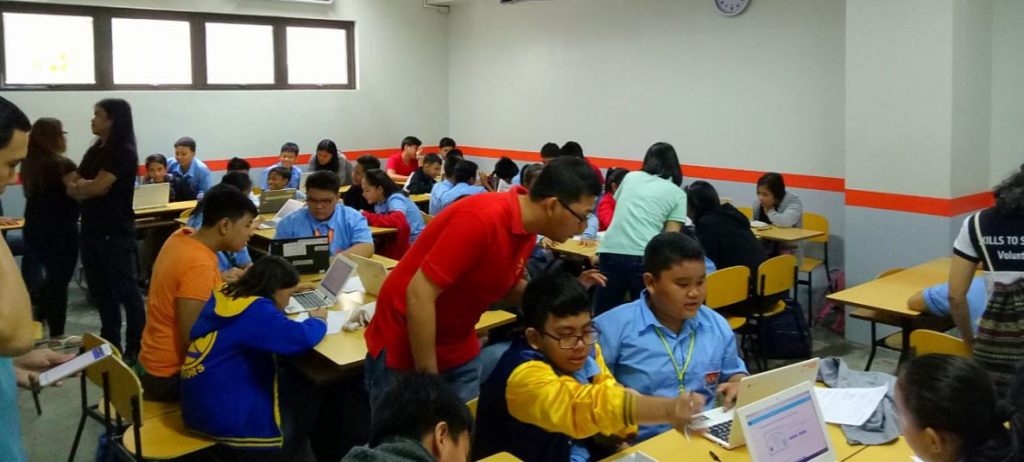
APEC Schools, in partnership with Accenture Philippines, is running the Hour of CodeTM Program for all Grade 7 students across its APEC Schools branches. Together with volunteers from Accenture Philippines, APEC will be organizing computer-coding sessions where every student will be learning the fundamentals of computer programming to help them prepare and succeed in future academic pursuits and employment.

APEC-Shools-Joins-Hour-of-Code-Loval-Management

To strengthen the initiative, APEC is collaborating with Accenture to share its technology knowledge and expertise. As a strong advocate of adoption of STEM (Science, Technology, Engineering and Mathematics) education among today’s youth, Accenture has been supporting Hour of Code activities in the country since 2015. Globally, it has conducted Hour of Code activities in close to 200 cities around the globe. APEC will be conducting An Hour of Code sessions that will cover more than 3,000 Grade 7 students from all APEC Schools Branches by the end of this school year.

APEC-Schools-Joins-Hour-of-Code-Global-Movement-2

Under the program, the one-hour introduction to computer science is designed to demystify “code” and provide a fun way of learning computer programming basics. The program aims to foster interest and broaden participation in the field of computer science. It has since become a worldwide effort to celebrate computer science, starting with 1-hour coding activities but expanding to various community efforts.

APEC-Schools-Joins-Hour-of-Code-Global-Movement

With the pervasiveness of technology, students’ ability to succeed in any chosen field will increasingly depend on understanding how technology works. At APEC Schools, the use of technology is deeply integrated into the teaching and learning process. Learning with and about technology develops the students’ problem-solving skills, logic, and creativity. It also provides the foundation for success in any 21st-century career path.

APEC-Schools-Joins-Hour-of-Code-Global-Movement

Operated by AC Education, an Ayala company, APEC Schools is the largest private, non-sectarian chain of high schools in the Philippines. It aims to transform millions of lives by providing high-quality yet affordable education and by producing graduates that are ready for college and professional employment.

###

* APEC Schools is operated by AC Education, an Ayala company and presently has 16,200 high school students across 23 branches in the NCR, Cavite, Rizal, and Batangas.

** Accenture is a leading global professional services company, providing a broad range of services and solutions in strategy, consulting, digital, technology and operations. Combining unmatched experience and specialized skills across more than 40 industries and all business functions – underpinned by the world’s largest delivery network – Accenture works at the intersection of business and technology to help clients improve their performance and create sustainable value for their stakeholders. With more than 375,000 people serving clients in more than 120 countries, Accenture drives innovation to improve the way the world works and lives. Visit us at www.accenture.com.

***The ‘Hour of Code™’ is a global initiative by Computer Science Education Week[csedweek.org] and Code.org[code.org] to introduce millions of students in 180+ countries to one hour of computer science and computer programming.

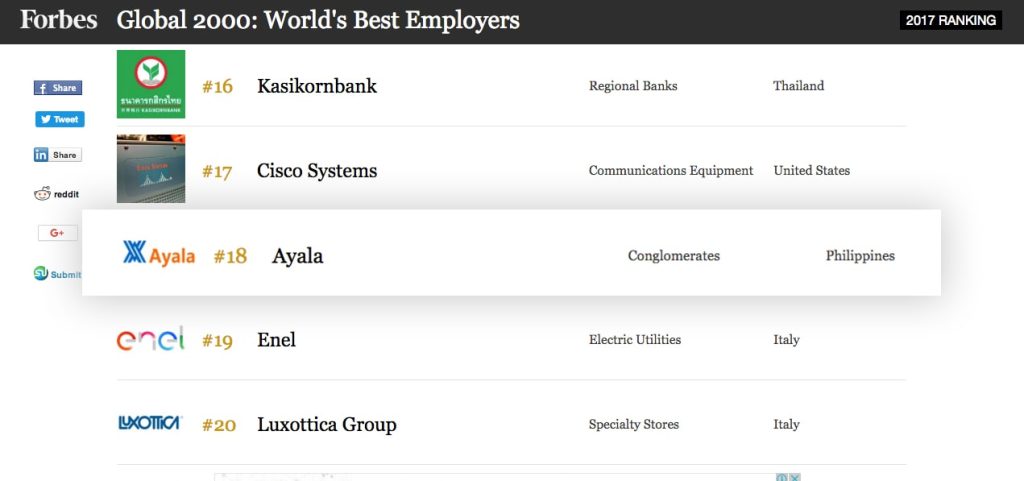
Ayala is Top 18 in Forbes 2000 List of World’s Best Employers in 2017

Forbes Global 2000, an annual ranking of the top 2,000 public companies in the world by Forbes Magazine, ranked Ayala top 18 in its first-ever list of the World’s Best Employers in 2017. The news sparked pride among #AyalaCitizens. Among those at the top of the list were Google’s parent company, Alphabet; Microsoft; the Japan Exchange Group; and Apple. 
More than 36,000 global recommendations were analyzed by business intelligence portal, Statista, for Forbes magazine to come up with the World’s Best Employers list. Companies were evaluated based on internal and public perceptions of employees. The 500 companies receiving the highest total scores were awarded with the World’s Best Employers title.

See the full list here

Ayala-is-Top-18-in-Forbes-2000-List-of-Worlds-Best-Employers-in-2017

Ayala Chairman & CEO Is One of UN’s 2017 SDG Pioneers

Chairman and CEO Jaime Augusto Zobel de Ayala took the lead in Ayala Corporation’s group-wide effort to adopt a more imaginative approach to building sustainable businesses by creating platforms where social issues are made central to business strategy, guided by the UN’s 17 Sustainable Development Goals, of SDGs.

His leadership did not go unnoticed.

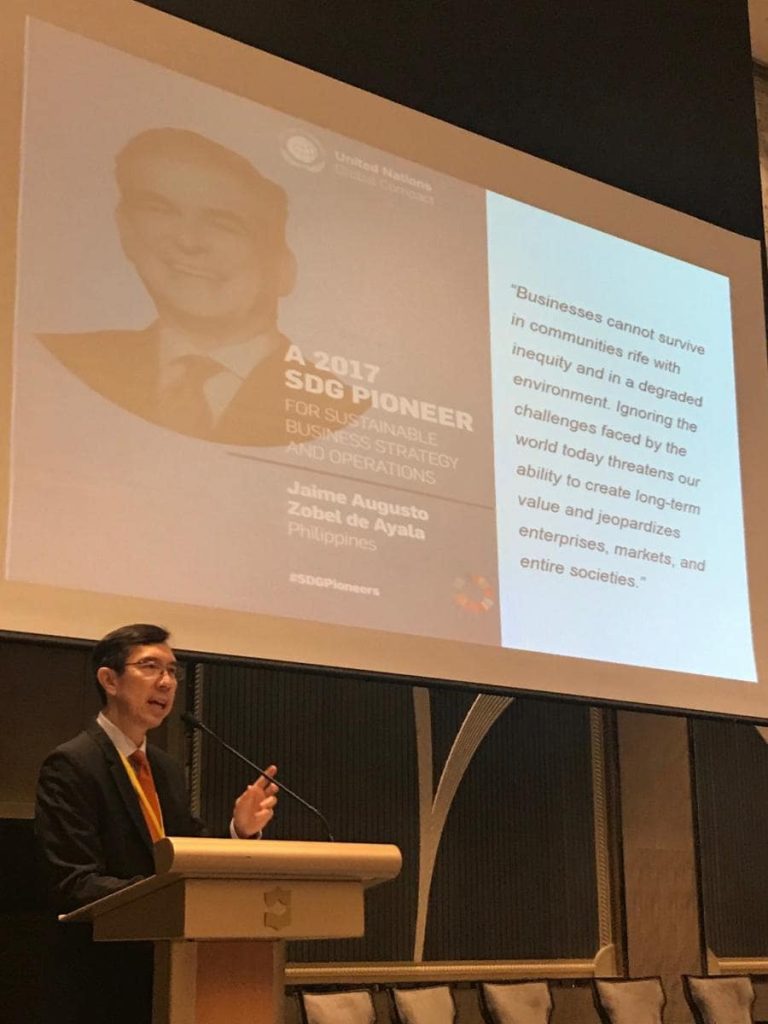
The UN Global Compact, a gathering of 800 global UN, business, government and civil society leaders, recognized Ayala Corporation’s sustainability strategy by distinguishing Mr. Zobel as an SDG Pioneer. The first SDG Pioneer from the Philippines, Mr. Zobel is one of ten individuals from around the world recognized for championing sustainability through their own companies and mobilizing the broader business community to take action in pursuit of the 17 UN SDGs.

Hundreds of nominations were received from diverse regions of the world, from which 10 finalists were selected, exemplifying how business can be a force for good in addressing the challenges we face as a global society.

“Each of the 2017 SDG Pioneers is exhibiting how companies and pioneering individuals can be a force for positive change in addressing the issues we all face today,” said Lise Kingo, UN Global Compact CEO and Executive Director. “Mr. Zobel has been impactful in reaching a wider segment of the business market through innovation and diversification. He has been a Pioneer in the inclusion of long-term sustainability in business strategy and operations.”

It was Mr. Zobel’s leadership that drove Ayala to embrace shared value creation, to better integrate the developmental challenges that society faces into Ayala’s strategies and business models. Apart from reinventing its business models to meet the needs of a wider segment of the population, Ayala has entered sectors critical to national development and inclusive progress: power, infrastructure, healthcare, and education.

Sustainability now plays a significant role in the Ayala businesses. Ayala Corporation drove the shift to the integrated reporting framework, which captures in detail the group’s positive impact on society through its contribution to the SDGs. Ayala Corporation is the first company in the Philippines to produce an integrated report. Another milestone is underway, as Ayala moves to include long-term sustainability targets for its businesses—which will form part of the companies’ and management’s key result areas.

 “I believe that now, more than ever, a deeper engagement with society is indispensable to the survival and success of private enterprises. From both a practical and moral standpoint, businesses cannot thrive in an environment rife with economic inequity,” said Mr. Zobel. “Ignoring these issues threatens our ability to create long-term value and jeopardizes the sustainability of the enterprise and markets.”

The world’s largest corporate sustainability initiative, the UN Global Compact calls on companies to align strategies and operations with universal principles on human rights, labour, environment and anti-corruption, and take actions that advance societal goals. In the Philippines, over 20 companies and non-business organization have joined the initiative, and the Global Compact Network Philippines has supported their efforts to advance sustainable business practices since 2016.

Mr. Zobel’s recognition as SDG Pioneer reinforces Ayala Corporation’s commitment to shared value creation, enhancing its business strategies and models in a way that addresses the evolving needs of Philippine society.

UN Global Compact Recognizes Ayala Corporation Chairman and CEO as a 2017 SDG Pioneer, first in the Philippines and Southeast Asia

Jaime Augusto Zobel de Ayala recognized for work in sustainable business strategy and operations.

NEW YORK, 14 September 2017 – Ayala Corporation’s sustainability strategy has been recognized by the UN Global Compact, which named Ayala Chairman and CEO Jaime Augusto Zobel de Ayala as one of the United Nations SDG Pioneers. The first SDG Pioneer from the Philippines, Mr. Zobel is one of ten individuals from around the world recognized for championing sustainability through their own companies and mobilizing the broader business community to take action in pursuit of the 17 Sustainable Development Goals, or SDGs.

“Each of the 2017 SDG Pioneers is exhibiting how companies and pioneering individuals can be a force for positive change in addressing the issues we all face today,” said Lise Kingo, UN Global Compact CEO and Executive Director. “Mr. Zobel has been impactful in reaching a wider segment of the business market through innovation and diversification. He has been a Pioneer in the inclusion of long-term sustainability in business strategy and operations.”

His leadership drove Ayala to embrace shared value creation, to better integrate the developmental challenges that society faces into Ayala’s strategies and business models. Apart from reinventing its business models to meet the needs of a wider segment of the population, Ayala has entered sectors critical to national development and inclusive progress: power, infrastructure, healthcare, and education.

Sustainability now plays a significant role in the Ayala businesses. Under Mr. Zobel’s leadership, Ayala Corporation drove the shift to the integrated reporting framework, which captures in detail the group’s positive impact on society through its contribution to the SDGs. Ayala Corporation is the first company in the Philippines to produce an integrated report. Another milestone is underway, as Ayala moves to include long-term sustainability targets for its businesses—which will form part of the companies’ and management’s key result areas.

Each year, the UN Global Compact celebrates a group of SDG Pioneers – business leaders doing an exceptional job of taking action to advance the Global Goals. Hundreds of nominations were received from diverse regions of the world, from which 10 finalists were selected, exemplifying how business can be a force for good in addressing the challenges we face as a global society. Each Pioneer will be recognized during the UN Global Compact Leaders Summit 2017 on 21 September in New York.

A Pioneers Selection Group, comprised of experts from the UN, academia, civil society and the private sector, ranked the nominees based on a set of criteria, resulting in the ten 2017 UN Global Compact SDG Pioneers. Access the list of 2017 SDG Pioneers.

“I believe that now, more than ever, a deeper engagement with society is indispensable to the survival and success of private enterprises. From both a practical and moral standpoint, businesses cannot thrive in an environment rife with economic inequity,” said Mr. Zobel. “Ignoring these issues threatens our ability to create long-term value and jeopardizes the sustainability of the enterprise and markets.”

The world’s largest corporate sustainability initiative, the UN Global Compact calls on companies to align strategies and operations with universal principles on human rights, labour, environment and anti-corruption, and take actions that advance societal goals. In the Philippines, over 20 companies and non-business organization have joined the initiative, and the Global Compact Network Philippines has supported their efforts to advance sustainable business practices since 2016.

The UN Global Compact Leaders Summit 2017 is a two-day gathering of the private sector, UN, Government and civil society to jump-start action to achieve the UN Sustainable Development Goals by 2030. Together, over 800 leaders from around the world are gathered in New York to identify how to unleash the business activities, thinking and innovation required for a new era of sustainability.


About Ayala Corporation

Ayala Corporation is one of the largest conglomerates in the Philippines with businesses in real estate, financial services, telecommunications, water, electronics manufacturing services, automotive, power generation, transport infrastructure, education, and healthcare. Its corporate social responsibility arm, Ayala Foundation, has programs that focus on education, youth leadership, sustainable livelihood, and arts and culture. www.ayala.com.ph.


About Jaime Augusto Zobel de Ayala

Jaime Augusto Zobel de Ayala is chairman and CEO of Ayala Corporation, one of the largest conglomerates in the Philippines, with interests in real estate, banking, telecommunications, water, industrial technologies, power, infrastructure, healthcare, and education.

Jaime is a member of various business and socio-civic organizations, including the JP Morgan International Council and Mitsubishi Corporation International Advisory Council. He chairs the Harvard Business School Asia-Pacific Advisory Board and the SMU Advisory Council in the Philippines, as well as working with the Harvard Global Advisory Council, the University of Tokyo Global Advisory Board and the Endeavor Philippines board of trustees. Jaime represented the Philippines on the Asia Pacific Economic Cooperation (APEC) Business Advisory Council from 2010 to 2015.

Jaime has received multiple recognitions for his public service and support of economic development in the Philippines, including the Presidential Medal of Merit, the Philippine Legion of Honor and the Order of Mabini.


For inquiries, contact:

Mia Bontol

Associate, Corporate Communications

Ayala Corporation

09175779582

bontol.mcu@ayala.com.ph

Ayala’s net income rose to P15.1 billion in the first-half, up 9% year-on-year

Ayala Corporation’s net income expanded nine percent in the first half of the year to P15.1 billion year-on-year, primarily driven by the solid contributions of its real estate and power generation businesses. Equity earnings amounted to P17.4 billion in the first semester, six percent higher from a year ago. This was underpinned by robust contributions from Ayala Land and AC Energy, which grew 17 percent and 64 percent, respectively.

In the second quarter, Ayala recorded a net income of P8.1 billion, up two percent from its year-ago level. The higher securities trading gains recognized by Bank of the Philippine Islands in the previous year tempered Ayala’s net earnings during the period.

“We are pleased with the overall strong performance of our businesses. The active portfolio management, new business initiatives, and financial discipline we employed in recent years—supported by a healthy domestic economy—continue to bolster Ayala’s growth trajectory,” Ayala President and Chief Operating Officer Fernando Zobel de Ayala said.

Real Estate

Ayala Land sustained its growth trajectory in the first semester, recording P11.5 billion in net income, an 18 percent-jump from a year ago on the continued expansion of its property development and commercial leasing businesses.

Revenues from Ayala Land’s property development business rose 32 percent to P44.3 billion, mainly driven by strong performance across its residential, office for sale, and commercial and industrial lots sales segments. Residential revenues jumped 27 percent to P36.8 billion on new bookings and project completions across all residential brands. Reservation sales expanded 11 percent year-on-year to P61.4 billion. In the second quarter alone, reservation sales reached a record P34.1 billion, up 12 percent from its year-ago level. Meanwhile, booked sales soared 22 percent from a year ago to P40.5 billion. In the first semester, Ayala Land launched P31.9 billion worth of residential and office for sale projects.

In the office for sale segment, revenues expanded 36 percent to P4.2 billion driven by bookings from the High Street South Corporation Plaza 2 project. Revenues from commercial and industrial lot sales surged more than twofold to P3.3 billion backed by lot sales in Arca South, Vermosa, and Naic.
In commercial leasing, mall leasing revenues rose 12 percent from its year-ago level to P7.9 billion lifted by the contributions of new malls including The 30th, Tutuban Center, and UP Town Center. Revenues from office leasing climbed to P2.9 billion, 14 percent higher year-on-year buoyed by contributions of newly opened offices such as the UP Town Center, UP Technohub Building P, and the Ayala Center Cebu Corporate Center. Moreover, hotels and resorts revenues improved six percent to P3.4 billion on higher occupancy and average room rates at El Nido Resorts. In addition, Ayala Land’s property management revenues grew 12 percent to P816 million driven by an increase in managed properties and higher carpark volume. Altogether, Ayala Land’s recurring income business contributed 36 percent of its net income in the first half of the year.

Banking

Continued investments to ramp up its digitization strategy coupled with lower securities trading gains tempered Bank of the Philippine Islands’ net income in the first semester to P11.7 billion, eight percent lower from its year-ago level.

Revenues ended flat at P35.3 billion as the solid growth in BPI’s core banking business balanced out a lower non-interest income. The bank posted P23.5 billion net interest income, 14 percent higher year-on-year on the back of higher asset yields and an improved loan-to-deposit ratio. Non-interest income dropped 18 percent to P11.8 billion owing to a slowdown in securities trading. The decline was partly tempered by BPI’s fee-based business, which grew 18 percent from the previous year, driven by cards and payments, service charges, and investment banking.

BPI’s loan book expanded 17 percent to P1.1 trillion, driven by corporate loans, which accounted for 79 percent of the bank’s loan portfolio in the first semester. The bank continues to improve its asset quality with gross 90-day non-performing loans ratio at 1.5 percent from 1.6 percent in the previous year, while reserve cover stood at 126 percent during the period. Total deposits grew eight percent to P1.4 trillion. The bank’s current and savings accounts ratio stood at 73 percent.

As part of its commitment to widen its reach to underbanked and underserved Filipinos, BPI relaunched in July its microfinance arm, BPI Direct BanKo to service the needs of self-employed micro-entrepreneurs (SEMEs). BPI Direct BanKo currently operates 24 branches and micro-banking offices (MBOs) with a target to open 100 new branches and MBOs by year end.

Telecom

Globe Telecom sustained its topline growth on robust demand for data-related services across its product segments, with revenues expanding five percent to P62.9 billion in the first half of 2017.

Mobile revenues rose five percent to P48.3 billion, lifted by strong demand for mobile services. Mobile data revenues jumped 13 percent as mobile data traffic surged 85 percent to 280 petabytes during the period. Meanwhile, mobile subscribers dipped three percent to 59.7 million in the first semester as a result of Globe’s shift in reporting prepaid subscribers who do not reload 120 days to 90 days of inactivity, which started in the first quarter of 2017.

Meanwhile, home broadband revenues grew eight percent to P7.7 billion, in step with a higher home broadband subscriber base which also improved eight percent to 1.2 million. In the first semester, data-related services accounted for 53 percent of Globe’s total revenues.

Higher depreciation, interest expense, and costs related to the acquisition of San Miguel’s telecom assets weighed down on Globe’s net earnings, which dropped 10 percent to P8.1 billion in the first half of the year. Excluding costs related to the San Miguel deal, net earnings would only be four percent lower.

Globe ended the first half of the year with earnings before interest, taxes, depreciation, and amortization (EBITDA) of P27.3 billion, six percent higher from a year ago. Globe’s EBITDA margin improved to 43.3 percent from 42.8 percent in the previous year.

In its drive to continue improving customer connectivity and increase data traffic, Globe in the second quarter rolled out more than 1,100 cell sites that utilize the LTE frequencies acquired from the San Miguel deal. It also deployed close to 150,000 broadband lines in the same period.

Water

The steady performance of its Manila Concession coupled with increasing contributions from its domestic subsidiaries drove the three percent increase in Manila Water’s net income to P3.2 billion in the first half of the year. Revenues rose four percent to P9.1 billion buoyed by the continued expansion of its businesses outside Metro Manila.

Manila Water’s domestic business, Manila Water Philippine Ventures, recorded an attributable net income of P306 million, up 20 percent from a year ago, on strong contributions from Laguna Water and Estate Water. Laguna Water’s net income rose 49 percent to P148 million, lifted by the expansion of coverage in Laguna province. Meanwhile, Estate Water’s net earnings jumped 69 percent to P122 million, backed by increased connections and billed volume growth. Net income from Manila Water’s non-Manila concession businesses reached P584 million, representing 18 percent of Manila Water’s consolidated net income from 15 percent during the previous year.

The Manila Concession booked a three percent increase in net income to P3 billion driven by a one percent-improvement in billed volume resulting from sustained demand of commercial customers. Operational efficiency in the Manila Concession remained strong, with non-revenue water ratio at 12.8 percent and collection efficiency at 99 percent.

On a consolidated basis, Manila Water’s billed volume rose three percent to 366.9 million cubic meters in the first half of the year.

In June, Manila Water acquired additional shares of Saigon Water Infrastructure Corporation (“SII”), bringing its total ownership of the company to 37.99 percent. The transaction is in line with Manila Water’s investment strategy in Vietnam and in Asia.


Industrial Technologies

AC Industrials registered a net income of P739 million in the first half of the year, three percent lower from the previous year, as the lower contributions of its vehicle retail business tempered the gains from the robust performance of its electronics manufacturing arm.

Its electronics manufacturing unit, Integrated Micro-Electronics, Inc. (IMI), registered a net income growth of 14 percent to US$17 million, bolstered by its organic businesses in the Philippines, China and Mexico operations, as well as fresh contributions from newly acquired businesses. IMI’s total revenues grew 22 percent to US$501 million. Newly acquired businesses VIA Optronics and STI Enterprises Ltd. posted US$72.5 million in combined revenues, with one month contribution from STI.

AC Industrials’ vehicle retail business posted P14.7 billion in revenues, up 37 percent year-on-year, mainly driven by strong sales across all brands. However, this was offset by the lower dividend income from Isuzu Philippines Corporation, resulting in a 21 percent-decline in the net income of AC Industrials’ vehicle retail segment to P319 million.

In July, AC Industrials acquired MT Technologies GmbH, a German-based automotive supplier of models, tools, and plastic parts for automotive original equipment manufacturers (OEMs) and automobile tier 1 suppliers. In addition, its manufacturing facility for KTM motorcycles in Laguna commenced operations in June. These investments form part of AC Industrials’ strategy to increase its competence and capabilities in the automotive value chain and complement existing businesses in manufacturing services and vehicle retail.

Power Generation

In power generation, AC Energy’s net income surged 64 percent to P949 million in the first semester on the back of a favorable wind regime, improved efficiencies of its operating coal plants combined with feed-in-tariff earnings from its solar plant, as well as fresh contributions from Chevron’s geothermal assets in Indonesia.

AC Energy continues to pursue domestic and foreign expansion initiatives as it targets to double its attributable power generating capacity to 2,000 megawatts by 2020. In July, AC Energy entered into an agreement with UPC Renewables for the development of small island power projects in Indonesia.

Also in July, AC Energy, together with Star Energy, transferred 99 percent of its consortium interest in ACEHI-STAR Holdings to AllFirst Equity Holdings. ACEHI-STAR is the special purpose company that signed a share sale and purchase agreement with Chevron Philippines to acquire its geothermal assets, subject to certain conditions precedent.

Infrastructure

AC Infrastructure continues to improve efficiencies in its three public-private partnership projects. Light Rail Manila Corporation, the operator of LRT-1, averaged close to 430,000 in daily ridership in the first semester. Since taking over operations in 2015, it has increased the number of light rail vehicles by 35 percent to 104. Meanwhile, the Muntinlupa-Cavite Expressway is now serving nearly 28,000 vehicles per day, a 23 percent increase from its year-ago level. In addition, the Beep ticketing system now has nearly four million cards in circulation and has processed approximately P7.2 billion in transactions across rail, bus, and retail platforms since its release in 2015.

Social Infrastructure

In healthcare, AC Health continues to widen access to affordable medicine and primary healthcare services through Generika and FamilyDOC. In the first half of the year, Generika’s revenues reached P1.5 billion, up 10 percent year-on-year bolstered by higher retail and distribution sales across its branch network. As of the first half of 2017, Generika had a footprint of 698 branches nationwide. Meanwhile, FamilyDOC opened four new clinics in Las Pinas City, Imus, Cavite and Paranaque City. Since opening its pilot clinic in 2015, FamilyDOC has served over 30,000 unique patients as of July 2017 and has a branch network of 10 clinics in the southern Greater Manila Area. FamilyDOC aims to launch 14 more clinics this year.

In education, AC Education is completing enrollment for school year 2017-2018 in both APEC Schools and University of Nueva Caceres (UNC). As of end-July 2017, enrollment in APEC schools reached 16,200 enrollees, 54 percent higher year-on-year as it welcomes its first batch of Grade 10 Junior High School students and Grade 12 Senior High School students. APEC Schools is present in 23 sites across Metro Manila, Rizal, Cavite, and Batangas. Moreover, UNC increased its student population by five percent to 8,054 despite the absence of incoming freshmen in the second year of implementation of the K-12 law.

Balance Sheet

Ayala’s balance sheet remains at a comfortable level. Cash at the parent level amounted to P12.1 billion, while net debt stood at P64.4 billion. Net debt-to-equity ratio for the period was 0.67 at the consolidated level and 0.60 at the parent level. Ayala’s loan-to-value ratio or the ratio of its parent net debt to the total value of its investments was 9.8 percent in the first half of the year.

In line with Ayala’s prudent cash and debt management strategy, Ayala’s Board of Directors approved the filing of a three-year shelf registration with the Securities and Exchange Commission of up to P30 billion debt securities in one or more tranches. The shelf registration provides Ayala financial flexibility to issue debt instruments opportunistically as market permits.

Ayala registers P6.9 billion net income in Q1, up 20%

Ayala Corporation’s net income expanded 20 percent in the first quarter of the year to P6.9 billion driven by the robust results of its banking and real estate businesses, as well as the solid earnings of its emerging businesses in power and industrial technologies.

Strong equity earnings from its businesses, which climbed 18 percent year-on-year to reach P8.5 billion, lifted the conglomerate’s performance during the period. This was led by equity earnings from the Bank of the Philippine Islands and Ayala Land, which expanded 27 percent and 18 percent, respectively. In addition, Ayala’s emerging businesses posted higher equity earnings, particularly AC Energy and AC Industrials, expanding 26 percent and 22 percent, respectively.

On a quarter-on-quarter basis, Ayala’s net income climbed 9 percent from the fourth quarter of 2016 on the back of the robust performance of its banking business.

“We are pleased to see our businesses sustain their positive performance in the first quarter. As a group, we continue to search for value-accretive opportunities not only to create new sources of financial growth, but also to remain relevant to our stakeholders. As our core businesses maintain their growth trajectories, we are encouraged by the progress of our emerging businesses. In particular, our power, infrastructure, and industrial technologies units are pursuing strategic opportunities to scale up and over time bring significant value to our portfolio,” Ayala President and Chief Operating Officer Fernando Zobel de Ayala said.

Real Estate

Ayala Land posted P5.6 billion in net income during the period, 18 percent higher year-on-year on the continued expansion of its property development and commercial leasing businesses.

Property development revenues jumped 21 percent to P19.7 billion, backed by the residential, office for sale, and commercial and industrial lots segments. Residential revenues grew 11 percent to P16.6 billion, supported by higher bookings and project completions across all residential brands. Bookings from Alveo’s Park Triangle Tower and Avida’s Capital House, both in Bonifacio Global City, as well as the Alveo Financial Tower in the Makati Central Business District, drove the 26 percent increase in office for sale revenues to P1.5 billion. Meanwhile, commercial and industrial lot revenues expanded tenfold to P1.6 billion, fueled by lot sales in Vermosa, Arca South, and Naic.

Mall and office leasing revenues continued to improve, reaching P7.1 billion, up nine percent from a year ago. Ayala Land booked P3.8 billion in mall leasing revenues during the period, a 12 percent increase year-on-year. This was driven by the contributions from newly opened malls, namely: The 30th in Pasig City, UP Town Center in Quezon City, South Park in Muntinlupa City, Ayala Malls in Legaspi, and the addition of Tutuban Center in Manila. Office leasing revenues rose eight percent to P1.5 billion on higher average rent in established offices and contributions from newly opened office spaces. Hotel and resorts revenues were stable at P1.7 billion, up four percent from a year ago.

In the first three months of the year, Ayala Land deployed P21.8 billion in capital expenditures. Of this amount, 46 percent was used for the completion of residential projects, while 37 percent was channeled into commercial leasing projects. The remaining amount was allocated for land acquisition and the developments of Ayala Land’s existing estates.

Banking

Bank of the Philippine Islands booked robust results in the first quarter of the year with net income surging 26 percent to P6.3 billion buoyed by the consistent performance of its core lending business. This was further boosted by its fee-based businesses and gains from securities trading and property sales.

BPI’s total revenues jumped 18 percent year-on-year to P18 billion. Net interest income expanded 15 percent to P11.5 billion, bolstered by higher asset yields and the growth of its loan portfolio. Non-interest income jumped 23 percent to P6.5 billion on securities trading gains, service charges, underwriting fees, and gains from asset sales.

Cognizant of customers’ evolving needs and preferences, BPI increased its investments in tools and processes to ensure greater convenience and security for customers amid an increasingly digital environment. The bank’s operating expenses during the period amounted to P8.7 billion, up 11 percent owing to additional manpower, regulatory costs, and spending on operational infrastructure. Despite higher operating expenses, BPI’s cost-to-income ratio improved to 48.6 percent compared to 51.4 percent during the same period last year. The bank ended the first quarter with return on assets of 1.5 percent and a return on equity of 15 percent, up 0.14 and 1.89 percentage points, respectively.

BPI’s loan portfolio expanded 20 percent year-on-year to P1.03 trillion. The bank maintains a healthy asset base with gross 90-day non-performing loans improving to 1.5 percent compared to its year ago level of 1.7 percent. Reserve cover grew to 123.7 percent from 114.2 percent in the same period last year. Total deposits stood at P1.4 trillion, up 11 percent, with low-cost deposits amounting to 73.9 percent of the full amount.

Telecom

The sustained momentum in data-related services across mobile data, home broadband, and corporate data segments drove Globe Telecom’s topline growth in the first three months of the year, which improved four percent to P31 billion. Mobile data revenues climbed eight percent to P10 billion, with this segment now representing 42 percent of total mobile revenues. Data-related services accounted for 53 percent of Globe’s total service revenues during the period.

Despite this improvement in revenues, the higher depreciation, interest expense, and costs related to the strategic acquisition of San Miguel’s telecom assets weighed on Globe’s net income, which declined 13 percent to P3.8 billion in the first quarter. Stripping off the impact of costs related to the acquisition of San Miguel’s telecom assets, Globe’s normalized net income declined by only four percent.

Globe’s earnings before interest, taxes, and depreciation slightly rose two percent to P13.3 billion as the increase in revenues was pared by higher operating expenses. EBITDA margin during the period stood at 43 percent, slightly lower from its year ago level. Globe booked P6.4 billion in depreciation expenses, four percent higher as a result of the aggressive infrastructure investments it made in recent years.

Acquisition of high-value prepaid subscribers slightly lifted Globe’s mobile subscriber base, which stood at 58.6 million in the first quarter, two percent higher than a year ago. Globe’s prepaid segment accounted for 99 percent of subscriber identification modules (SIM) during the period. Effective this reporting period, Globe will report subscriber information based on a churn rate of 90 days from the previous 120 days.

As part of its commitment to improve LTE capacity and network coverage, Globe has deployed 260 LTE700 and 30 LTE2600 sites during the first quarter using frequencies obtained from the San Miguel acquisition. It also launched 155 sites utilizing the LTE1800 frequency.

Water

Because of higher costs from new investments and expansion initiatives, Manila Water posted a two percent decline in its net earnings to P1.4 billion in the first quarter. Consolidated revenues, however, rose three percent to P4.4 billion owing to a slight increase in billed volume during the period.

Manila Water continues to pursue growth opportunities outside the Manila Concession. In the first quarter, its businesses outside the Manila Concession accounted for 19 percent of its net income. Manila Water Philippine Ventures, Manila Water’s holding company for its domestic subsidiaries outside the Manila Concession, recorded attributable net income of P145 million, 36 percent higher than the previous year, bolstered by the robust performance of Estate Water, Laguna Water, and Cebu Water.

Estate Water recorded a net income of P66 million, surging nearly fourfold as its operations continued to ramp up. Strong billed volume growth in Laguna Water and Cebu Water drove their net earnings during the period, which expanded 24 percent to P54 million, and 46 percent to P19 million, respectively.

Revenues from the Manila Concession were flat at P3.6 billion, tracking the one percent growth in billed volume during the period. Non-revenue water stood at 12.2 percent, a one percentage-point decline from the previous year. Collection efficiency stood at 102 percent.

Manila Water continues to ramp up its expansion initiatives geographically and across its products and services. In the Philippines, Manila Water Philippine Ventures through Laguna Water will be taking over the water distribution of Calauan town, further expanding its footprint in the province of Laguna. Moreover, Boracay Water started supplying bulk water to the municipality of Malay in the province of Aklan. In Vietnam, Manila Water Asia Pacific completed the negotiations with Tan Hiep, the water supplier of Saigon Water Corporation in the Hoc Mon District of Ho Chi Minh City, for a bulk water operations project. It also won a full water distribution operations contract to serve the central highlands of Gia Lai Province in Vietnam. Manila Water Total Solutions launched in April the 500-milliliter “Healthy Family Mini” purified water.

Industrial Technologies

In March, AC Industrials assumed Ayala’s 50.7 percent ownership in Integrated Micro-Electronics originally held by AYC Holdings. The transaction consolidated Ayala’s existing assets in manufacturing, and vehicle distribution and dealership under AC Industrials, to execute Ayala’s vision to assemble a portfolio of businesses that own, develop, enable, manufacture, and commercialize automotive and other industrial technologies platforms.

AC Industrials recorded P332 million net income, 22 percent higher from the previous year driven by the robust performance of both its electronics manufacturing and automotive retail businesses.

Solid topline growth and better gross profit margins lifted IMI’s net income, which expanded 33 percent to US$8.7million (P434.1 million). As of 2016, IMI was the 20th largest global EMS provider according to Manufacturing Market Insider, a notch higher from its 2015 ranking.

IMI’s revenues climbed 18 percent to US$235.9 million (P11.8 billion) led by its Europe, Philippine, and Mexico operations. In addition, the consolidation of newly-acquired VIA Optronics boosted IMI’s core businesses, contributing US$23.9 million in revenues during the first quarter of the year. IMI’s gross profit reached US$28.9 million, 38 percent higher from the previous year, with gross profit margin improving to 12.2 percent from its year ago level of 10.5 percent.

In April, IMI announced the acquisition of an 80 percent stake in UK-based STI Enterprises Limited, subject to closing conditions and regulatory approval. STI provides electronics design and manufacturing solutions in both printed circuit board assembly and full box-build manufacturing for high-reliability industries. This acquisition will enable IMI to expand into the aerospace and defense markets while strengthening the industrial segment in manufacturing, as well as in technology development and engineering.

AC Industrials’ automotive business recorded a net income of P117 million, 10 percent higher than the previous year on the back of robust sales of its Honda BR-V and Civic models. Revenues rose 37 percent to P7.6 billion driven by robust demand across all brands.

KTM Philippines manufactured its first motorcycle, with the formal opening of its manufacturing facility set to commence in June of this year. Located in IMI’s complex in Laguna, the facility has an estimated annual production capacity of 20,000 motorcycles, the majority of which is meant for export to China and to Southeast Asian countries.

Power Generation

Sustained operating efficiencies of its power assets drove AC Energy’s results in the first quarter. Net income surged 25 percent to P313.7 million. This was achieved despite the annual maintenance for AC Energy’s conventional energy assets, South Luzon Thermal Energy Corporation and GNPower Mariveles, which was scheduled during the period.

AC Energy continues to execute on its 2020 target of doubling its total attributable capacity to 2,000 megawatts, while increasing its portfolio of renewable energy to 1,000 megawatts. In March, it acquired 100 percent ownership of Bronzeoak Clean Energy and San Carlos Clean Energy. These bring complementary strengths to AC Energy, specifically in renewable energy development, management, and operations.

Also in March, as part of an Indonesian consortium, AC Energy completed the acquisition of Chevron Global Energy Inc. and Union Oil Company of California’s geothermal assets and operations in Indonesia. These assets have a combined capacity of approximately 637 megawatts of steam and power, and will contribute to AC Energy’s growing portfolio of renewable energy assets.

Infrastructure

AC Infrastructure continues to optimize the operations of its three public-private partnership projects. Light Rail Manila Corporation, which manages and operates LRT 1, increased average daily train trips to 471 from 462 during the same period in 2016. It averaged close to 445,000 daily riders for the first three months of the year. The Muntinlupa-Cavite Expressway averaged close to 28,000 vehicles per day, up 29 percent year-on-year as of March 2017. Meanwhile, the Beep ticketing system now has close to 3.1 million cards in circulation since its launch in 2015. AC Infra reported a net income of P9 million for the first quarter of the year.

In March, AC Infra, together with SM Investments Corporation, submitted its first unsolicited proposal to the Department of Public Works and Highways to design, finance, construct, operate, and maintain for a 35-year period an 8.6-kilometer elevated toll road linking Sta. Mesa, Manila to the Mall of Asia Complex in Pasay City via the Central Business District. The proposed C3 Elevated Expressway (C3EX) completes the Circumferential Road 3 and is expected to reduce traffic congestion along Epifanio Delos Santos Avenue and improve access to Manila Bay development areas, the Makati central business district, and the cities of Mandaluyong, San Juan, and Manila.

In May, LRMC broke ground for pre-construction work on the LRT-1 Cavite Extension. The project will connect the existing LRT-1 line to an 11.7-kilometer alignment with eight passenger stations located in Paranaque, Las Pinas, and Cavite.

Social Infrastructure

In healthcare, Generika’s revenues grew 10 percent year-on-year to P746.9 million driven by higher distribution and retail sales. As of the first quarter, Generika had a footprint of 684 stores nationwide. Meanwhile, AC Health’s full-service primary care community clinics, FamilyDOC, served close to 21,000 unique patients as of the first three months of the year. To date, AC Health operates six FamilyDOC clinics in the southern Greater Manila Area. FamilyDOC targets to open 18 new clinics this year, with the expansion to commence in July.

AC Education continues to deliver affordable, quality education in both secondary and tertiary levels. Its Affordable Private Education Center will welcome its first batch of Grade 10 junior high school students and Grade 12 senior high school students for the upcoming school year 2017 to 2018. It has a network of 24 school branches in the Greater Manila Area and surrounding provinces. In tertiary education, University of Nueva Caceres graduated 680 college students in March, its second batch under AC Education.

Balance Sheet

Ayala’s balance sheet remains healthy with ample capacity to undertake investments as well as cover its dividend and debt obligations. In April, Ayala redeemed its P10 billion, 7.20% fixed rate putable bonds due 2017. The amount was fully paid at the bond’s maturity date. As of the first quarter of the year, parent level cash stood at P24.2 billion, with net debt at P62 billion. Ayala’s net debt-to-equity ratio stood at 0.57x at the parent level and 0.65x at the consolidated level. The conglomerate’s loan-to-value ratio, the ratio of its parent net debt to the total value of its assets, was at 10.4 percent at the end of March 2017.