
Fernando Zobel De Ayala: 2018 Annual Stockholders’ Meeting President’s Report

Good morning to everyone.
We are pleased to report that 2017 was another strong year for Ayala. The aggressive expansion strategy we embarked on several years ago across our portfolio of businesses continues to bear fruit.

Our net income climbed 16 percent to ₱30.3 billion, with solid growth led by our real estate and power businesses.

We continue to lay the foundation for sustained growth, and ensure our resilience and relevance in the fast-paced business environment.

Our businesses have made significant progress towards both our 2020 goals, and our desire to help build the nation and uplift the lives of more Filipinos. This is what we mean when we speak of shared value—when the achievements of our businesses result in a greater positive impact on society.

INTRODUCTION: SIX THEMES

Today, we will depart from the traditional way we report our performance. Instead of a detailed discussion on our financial and operating results, we would like to focus on the tangible ways in which our businesses have had a positive impact on society. We have grouped our initiatives into six broad themes, which we believe appropriately represents our contribution in the industries where we operate, the lives of the communities we serve, and our country’s development agenda.

These six themes are Empowering Filipinos, Innovating in business, Accelerating broad-based development, Connecting communities, Transforming industries to improve quality of life, and Diversifying into new sectors for future growth.

EMPOWERING FILIPINOS

Let me start with the first theme: Empowering Filipinos.

When our businesses meet basic needs, and ensure access to critical services, we are able to contribute to human capital development and help empower our countrymen to achieve their aspirations.  

AC Education has continued to scale its operations to bring its specialized curriculum and programs to even more Filipino students. At the end of 2017, AC Education had a student population of approximately 16,000 across 23 APEC Schools and 8,000 in the University of Nueva Caceres in Bicol.

APEC uses a specially-designed curriculum that equips students with the skills and characteristics that employers look for. This is combined with a technology-based learning environment that creates a unique educational experience. Through APEC, Filipino students receive the education they need to go on to college, or to find employment.

Together with industry partners such as Globe, BPI, Convergys, and Accenture, the University of Nueva Caceres implemented a novel intervention to improve the employment prospects of graduating students. The Professional Employment Program or PEP places students in a working professional environment. It also develops skills such as English communication, critical thinking, and the practical application of technology.

This past school year, 89 percent of the UNC-PEP participants found employment within three months after graduation, compared to only 50 percent of students who did not undergo the program. UNC-PEP graduates went on to work for companies like BPI, Sutherland Global Services, Ford Philippines, and Telus Manila, among others. They also received average salaries that are 54 percent higher than those who did not join PEP.   

This is just the beginning, and AC Education is determined to work even harder to improve these numbers and reach more students.

Early this year, AC Education signed a non-binding term sheet for a potential merger with iPeople, which operates Mapua University in Metro Manila, Laguna, and Mindanao. Mapua consistently produces some of our country’s best engineers and technicians. We look forward to this partnership with iPeople and to combining our resources and capabilities to further develop our country’s human capital. 

AC Education also recently acquired a 96 percent stake in National Teachers College. NTC has made a name for itself through its track record in teacher education, having produced thousands of excellent teachers across different educational levels.

AC Education would introduce its governance system and unique capabilities to further enhance NTC’s long-held standards of excellence. Working together, we can positively impact the lives of even more Filipino students across the archipelago—producing even more capable, empowered, and skilled teachers for the next generation.

INNOVATING IN BUSINESS

Let me move on to the second theme, which is centered around “innovating in business.”

We are well aware that innovation is the key to any company’s survival, especially with the rapid pace at which industries are changing today. Innovation has long been a key driving force of Ayala’s longevity and ability to remain relevant across multiple macroeconomic and socio-political cycles in our country’s history. Today, we actively work to embed innovation in our core and make it part and parcel of how we do business.

Doing this has helped us evolve and transform our businesses, contribute to the growth of local industries, and serve our customers better. Let me cite a few examples, starting with one of our newest business units, AC Industrials.

Through AC Industrials, Ayala is establishing a foothold in the rapidly-evolving global industrial technologies sector, particularly in the automotive industry. Formed two years ago, AC Industrials is anchored on two of the Ayala group’s long-held businesses: our electronics manufacturing services unit IMI and our automotive retail unit. IMI, in particular, started as a homegrown manufacturing company more than three decades ago.

IMI has over time earned a niche in global electronics manufacturing. Today, it is the sixth largest electronics manufacturing services company for automotive and the 18th largest in overall electronics manufacturing services in the world. What was once a relatively small local operation now provides jobs to almost 17,000 people around the world.

AC Industrials has made strategic acquisitions in the past couple of years as it builds a unique portfolio of capabilities. Germany-based VIA Optronics is revolutionizing display systems, while Merlin Solar has developed unique and innovative solar solutions for applications in transport and infrastructure.

STI gives us exposure into technologically-advanced industries like aerospace and defense, while MT Technologies allows us to participate in the early design stages of a car.

All these strategic acquisitions are complementary with one another and give us access to disruptive technologies, industry knowledge, and innovations to capture the opportunities in global industrial technologies. It is a source of pride for all of us to be able to develop AC Industrials into a global player in advanced technologies.

AC Industrials can leverage its body of knowledge to move the Philippines up the global value chain, and help develop our local manufacturing sector and help stimulate economic development and job generation for Filipinos.

To complement this, IMI has a strong training program to upgrade the skills of its employees, who at a minimum, have high school diplomas. Through different platforms, including partnerships with local colleges, IMI employees are trained to operate sophisticated machinery and equipment and develop skills that allow them to remain relevant amid the transformation taking place in the manufacturing industry.

Another example is how we harness innovation to contribute to economic inclusivity. In our financial system, for instance, much work needs to be done to widen its reach and bring greater access to financial products and services to unserved areas. It is unacceptable that half of our adult population is not part of the formal banking system, and that 35 percent of our municipalities still have no physical access to a bank.

This is complicated further by the Philippines’ archipelagic setting, which makes it costly and inefficient for traditional banks to serve rural areas. A number of banking requirements also prove to be too stringent for the lower-income tier. Many current product offerings are also deemed unaffordable for the lower-income segment.

Ayala is doing its part to help alleviate this challenge. Globe’s fintech platform, Mynt, leverages technology to serve those who do not have access to any form of basic banking or formal lending transactions. Now a joint venture with Ant Financial, Mynt makes financial services accessible to segments of the population that would not otherwise qualify under traditional requirements.

Mynt’s business is built around the use of mobile phones: GCash is a mobile wallet and micropayments platform, while Fuse is a technology-based lending company.

The use of mobile phones to enable access to financial services is particularly relevant to the Philippine context, where the majority of Filipinos own at least one mobile phone. With many communities and barangays in rural areas, mobile phones can be used to literally connect Filipinos to the financial system.  

GCash, for example, is a way through which Filipinos can send money and pay their bills. Meanwhile, Fuse is a licensed lending institution that strives to understand the loan needs of its customers to ensure that it provides the right products. Fuse allows clients to avail of loans ranging from ₱300 pesos to ₱300,000. It communicates updates and approvals to their clients through mobile phones. Last year alone, Fuse released ₱332 million through 66,000 loans, and we expect this to grow significantly in the coming years to reach more customers. 

Technology is not just changing the way we pay our bills or take out loans—it is also changing the way we shop. In many countries around the world, customer preference is shifting to e-commerce from traditional brick-and-mortar retail stores.

In our country, this trend is taking hold, through increasing access to the internet and more affordable smartphones. While more Filipinos are shopping online, e-commerce in the country today still represents under one percent of the total retail market. However, with increasing adoption of mobile and digital platforms, this number is expected to grow to five percent by 2025.

To take advantage of the high growth potential of e-commerce, the Ayala group has invested in Zalora, the most popular fashion retail online platform in the Philippines.

Zalora already receives around 100 million visits every month. Investing in this platform gives us the opportunity to understand the new needs of shoppers; learn from its operations; and harness synergies with Ayala Land, which, as you know, operates shopping malls around the country.

ACCELERATING BROAD-BASED DEVELOPMENT

While many are benefitting from our country’s economic growth, there remains the challenge of narrowing the income gap and accelerating broad-based development,  which is the third theme I want to highlight.  As we ramp up the scale of our businesses, we want to make sure that we accelerate the progress of communities and the upliftment of our countrymen.

For instance, BPI, which has traditionally been strong in corporate and retail banking, is now widening its reach to provide financial services to the underserved and unserved segments of the population.

BPI is now providing greater focus to the small and medium enterprises of the country. We know that they make up the vast majority of Filipino businesses, and are crucial in driving economic growth.

As a dedicated group for SMEs, BPI has created a new unit called the Business Banking Segment. This group will work with small and medium enterprises to help them make the best financial decisions to grow their businesses. The BPI Business Banking Segment provides loans to SMEs ranging from ₱300,000 to ₱100 million pesos.

Complementing this is BPI Direct BanKo, which provides financial solutions to self-employed microentrepreneurs.

BanKo provides micro-business owners access to loans with simple administrative requirements. With loans ranging from ₱20,000 to ₱300,000, this platform reduces reliance on unlicensed moneylenders that may charge exorbitant rates.

In its first year of operations, BPI Direct BanKo has already provided over ₱400 million in loans to more than 8,000 clients. From only nine pilot branches in 2016, it has grown elevenfold to a network of 103 branches and microbanking offices in just a year. We aim to widen the reach of our operations further, to achieve total loans of ₱2 billion at the end of 2018. By 2022, we are targeting our total loans disbursed to be six times bigger.

CONNECTING COMMUNITIES

The fourth theme I want to highlight is the critical need to connect communities. Through Globe and AC Infrastructure, we are ensuring that Filipinos can stay connected to each other, and that people, goods, and services can easily and safely move from point to point.

As a first example, Globe has established its number one position in the telecommunications industry and its identity as the purveyor of the Filipino digital lifestyle.

It has consistently deployed massive amounts of capital in recent years to improve its network infrastructure, towards delivering faster and more reliable internet speeds. With capital expenditures of about US$800 million annually, Globe is working to achieve its goal of ensuring first-world internet connectivity for Filipino consumers and businesses.

Globe also offers an expanding variety of content for consumers: from the social media platforms that help customers keep in touch with friends and family to entertainment channels that delight customers, including Netflix, Disney, and Spotify.

The United Nations has declared internet access as a human right, and Globe is doing its part to make sure that all Filipinos have this. In 2017, Globe connected 1.3 million Filipino homes through high-speed internet. It is well on its way to achieving its goal of connecting two million homes in 20,000 barangays by 2020. It also has a goal to provide mobile services to 95 percent of cities and municipalities in the Philippines by the end of the year.

Meanwhile, AC Infrastructure continues to contribute to the Philippines’ need for efficient transport infrastructure. Through LRMC, it has significantly improved the service provided by the LRT-1, the oldest elevated rail line in the country. Since taking over operations in 2015, AC Infra in partnership with Metro Pacific, has increased the number of Light Rail Vehicles in operation, from 77 to 109.

Within a short span of time, other improvements have been made, which have resulted in shorter time between trips and 99 percent train punctuality in 2017. Today, it only takes an average of eight minutes from arrival at the train station to boarding a train.

This has allowed the LRT-1 to accommodate even more passengers. It has an average daily ridership of 435,000, a 12 percent improvement since LRMC took over the operations in late 2015. Clearly, improving the quality of all rail systems will result in significant benefits to millions of Filipinos.

AC Infrastructure continues to look for opportunities to augment our country’s transportation challenges. It has submitted unsolicited proposals to government to build much-needed infrastructure projects.

One of the most critical infrastructure needs of the country is the rehabilitation of the Ninoy Aquino International Airport. NAIA was originally built to handle only 31 million passengers every year. Last year, it handled over 42 million passengers. We have all seen how NAIA has been left behind by its regional peers in terms of airport development.

Early this year, as part of a consortium with Changi Airports, one of the world’s premier airport operators, and six other leading Filipino companies, AC Infra submitted an unsolicited proposal to redevelop NAIA. The proposal entails improving and expanding the airport’s capacity to serve passenger traffic, which has grown significantly and will continue to grow in the coming years. The consortium is prepared to spend ₱102 billion over the next five years to develop a modern airport complex that will meet the long-term passenger demand at NAIA and transform it into a world-class facility and a regional air transport hub.

TRANSFORMING INDUSTRIES

Ayala’s drive to build better businesses has created innovative business models, and transformative products and services that have redefined industries and uplifted the quality of life of our customers.

With a solid track record in diversified segments of property development, Ayala Land is widely recognized for its unique expertise to develop large-scale, masterplanned mixed use estates in different parts of the country.

In building these estates, Ayala Land pays special attention to the environment and in providing a better quality of life for the communities it serves.

To improve the overall urban experience in its established estates such as Makati, Nuvali, and Bonifacio Global City, Alabang, and Cebu, Ayala Land ensures pedestrian mobility and transit connectivity. It also incorporates transit terminals in all its 25 estates to create a positive commuting experience and ease vehicular traffic in and around the area.

In addition, Ayala Land ensures sufficient green space across its developments to provide areas for leisure, environmental sustainability, as well as disaster resilience.

More importantly, Ayala Land’s developments serve as a platform for economic activity and concentrations of opportunity. These projects generate employment and business opportunities across the development cyclem, whether through the merchants and tenants of its malls and offices or the service providers in its construction, property management, sales, and hospitality segments. Moreover, Ayala Land deliberately integrates local enterprises and cultures in its developments to drive economic progress in those communities.

Ayala Land is also ramping up its presence in the tourism sector, which is an important growth engine for the Philippine economy. It has launched Lio in El Nido, the first masterplanned tourism estate in the country. Lio is being developed around the goal of providing leisure and recreation to visitors, while preserving the natural beauty and biodiversity of the environment.

Ayala Land has also expanded across the country. Traditionally, Ayala Land focused its developments in Metro Manila. Today, it is helping spur growth in other key areas, with over 10,000 hectares of developable land in 25 estates in 55 growth centers around the country.

Manila Water is another example of a business that has redefined an entire industry. One of the most successful public-private partnerships in the country, Manila Water has transformed the water services that 6.8 million Filipinos receive in the eastern part of Metro Manila.

When it took over operations at the height of the water crisis in the 1990s, potable water was supplied to only half of the residents of the metropolis, and the average availability of service was only about 16 hours per day.  Operations had steadily deteriorated due to massive underinvestment in the 120-year old pipeline network. It also had significant water systems loss, or wasted water due to faulty infrastructure and illegal connections, at about 63 percent.

Today, 94 percent of the population of Metro Manila’s east zone enjoys 24 hours of uninterrupted water supply, including low-income communities. Water systems loss is down to 11 percent, which is a global standard. Since taking over operations, Manila Water has replaced and laid down over 5,000 kilometers of pipes.

Moreover, Manila Water has a flagship program, Tubig Para sa Barangay, which was created to provide an affordable, steady, and predictable supply of potable water for marginalized communities.

Tubig Para sa Barangay is an innovative business model that included flexible financing options and socialized tariff scheme. Participants in the program enjoy savings on their water costs, the water-borne diseases in their areas have been reduced, and the overall sanitation conditions in their communities have improved.

The expertise Manila Water has built in over two decades has allowed it to work for the benefit of more communities. In the Philippines, Manila Water now operates in Clark, Laguna, Boracay, Cebu, Bulacan, Zamboanga, Tagum, Pangasinan, and Ilagan, among others.

Manila Water is also exporting its competencies to other markets in ASEAN. It is now the largest foreign investor in Vietnam’s water industry, and it has recently entered Thailand and Indonesia. Manila Water today is providing critical water services to over 17 million customers in the Philippines and in Vietnam.

Similarly, AC Health is another platform that has developed an innovative business model that works to improve healthcare services in the country. We entered healthcare because we recognized that significant gaps still exist in the sector, with a general lack of awareness on the importance of primary care.

Healthcare is an important part of the national agenda, but many challenges still remain. Studies conducted by AC Health showed that around 45 percent of middle-income Filipinos go a year without visiting a primary care doctor. Those that do, typically go to barangay health centers that are not well-equipped, or have to travel long distances to visit a public hospital.

In response to this, AC Health has put up a chain of community-based clinics called FamilyDOC. FamilyDOC combines primary care, laboratory, and pharmacy services in one facility, locating in high-density communities to provide maximum access.

Consultations at FamilyDOC can cost as low as ₱350, which is significantly cheaper than private hospitals. Follow-ups are also free within the first seven days after the first check-up.

Diversifying for growth

The sixth and final theme that I want to touch on is our effort in recent years to generate new sources of growth by diversifying into new businesses, new markets, and new products and services.

In 2011, Ayala entered new sectors in need of private sector participation. One of these sectors was power. We established AC Energy to serve as a new growth platform for Ayala, while doing our part to alleviate the power shortage the Philippines was facing. We knew that if the shortage continued, it would be a serious deterrent to investment and a massive challenge to sustained economic development.

In just six years, AC Energy has grown twentyfold: from about 80 megawatts of attributable capacity in 2011 to over 1,600 megawatts of attributable capacity today. Of this amount, 1,300 megawatts are sourced from thermal energy, while 300 megawatts are from renewable energy, particularly wind, solar, and geothermal.

AC Energy has started to contribute meaningfully to Ayala’s bottomline. In line with this, AC Energy has an ambitious target to double its capacity to 2,000 megawatts by 2020, of which 1,000 megawatts will come from renewable sources. We believe the development of renewable energy is critical to mitigate the impact of climate change, as well as ensure a more sustainable growth path for the Philippines and for the rest of the world.

AC Energy’s accelerated growth is contributing not only to the needs of the Philippines; it has now reached other Southeast Asian markets, particularly Vietnam and Indonesia. In Vietnam, with its partner the BIM group, AC Energy has just broken ground on the first phase of a 300 megawatt solar project in the Ninh Thuan province. Meanwhile, AC Energy completed last month the 75 megawatt Sidrap project, the first wind farm in Indonesia.

Beyond just a holding company, AC Energy today is transforming into a full-fledged energy platform, with development, operation, and retail capabilities.

AC Energy is just one among a number of Ayala enterprises that has brought its unique skills to foreign markets.

International diversification is in line with our groupwide target to achieve 10 percent of equity earnings contribution from international platforms by 2020. We are happy to report that we have made progress in this, with our overseas units contributing seven percent to our equity earnings for 2017.

Across the group, our various businesses have also expanded their products and services to cater to a wider segment of the market.

Through these examples, we have tried to show the role that Ayala plays as a key partner in development. We strive to create value that helps uplift the lives of our stakeholders.

CONCLUSION

Beyond operational results, Ayala has helped to drive inclusive economic growth by creating employment opportunities for 139,000 people yearly, and paying nearly ₱240 billion in taxes to the national government over the past six years.

Recognizing the impact that our businesses have across the country, the Ayala group has always sought to create value beyond success in financial and operating metrics. A commitment to national development has always been a defining pillar of the Ayala group. Last year, our Chairman and CEO was recognized by the United Nations Global Compact for Ayala’s commitment to sustainable business strategy and operations.

Anchoring our shared value creation process and sustainability framework on the UN Sustainable Development Goals has allowed us to report the different ways through which we contribute to the development of the country. With goals such as “No Hunger” and “Zero Poverty,” the SDGs represent the world’s ambitions for all people.

The success we have had in creating shared value and contributing to the achievement of the SDGs is due to the hard work of our board, management, and employees.

We are fortunate to be working with the best possible talent with a shared commitment to make a positive impact on society through the work that we do.

In closing, we would like to thank all our stakeholders for their strong engagement and continued trust and support for the Ayala group.

INTRODUCTION TO THE VIDEO

We would now like to present a short video to highlight our milestones and theme for 2017. Our groupwide annual reports this year were created under the theme, “Ayala in motion”, which represents our passion to make “every day” better for Filipinos.

As a committed partner in national development, we want to help drive inclusive economic growth by creating jobs and business opportunities, by making quality healthcare and education more affordable and accessible, by improving on the delivery of basic needs, and by investing in new technologies and innovations that will make for a better future. At Ayala, it’s not just about investing in business—it’s about improving lives.

Thank you.

Jaime Augusto Zobel De Ayala: 2018 Annual Stockholders’ Meeting Chairman’s Message

Good morning to everyone.
As we do every year, we have divided our presentations into two parts. I will present our broader strategic initiatives, while our President and COO will follow with a more detailed discussion on the operating achievements of the Ayala group.

Let me start with a broad overview of the external economic environment to put our review of the past year into perspective.

The improving trajectory for the global economy continued in 2017, with a recovery in trade, investment, and manufacturing recorded in a majority of economies across the world. However, economists cited the need for productivity-enhancing structural reforms in both advanced and developing economies to sustain this level of growth.

Aging populations, most evident in advanced economies, are expected to depress the expansion of employment. 

In the case of developing economies, the challenge lies in improving
physical infrastructure and human capital, aggravated by the fast pace at which disruptive technologies are changing the business landscape.

In ASEAN, despite worries of a slowdown brought about by protectionist initiatives in the US and geopolitical tensions in the Asia-Pacific and the Middle East nations, the region continued to perform strongly in 2017, bolstered by strong private consumption and exports.

Here at home, we continue to be optimistic about the Philippine economic environment. Even with the absence of election-driven economic growth from the previous year, our economy continued to perform strongly, recording a 6.7 percent expansion in 2017. The Philippines remains a top performer in ASEAN, trailing Vietnam, which registered 6.8 percent economic growth. 

Many anticipate the momentum to continue this year as the government’s aggressive infrastructure spending plans move to an execution phase and disposable incomes rise as a result of tax reforms. 

However, concerns around inflation have emerged as a result of rising commodity prices arising from higher global energy prices and a weaker peso.

Ayala has been a beneficiary of the country’s significant economic growth. This has served as a catalyst for us to unlock many opportunities to push us to develop new ideas, to incubate new businesses, and to explore prospects for disruptive innovation. 

We took advantage of this encouraging domestic environment to create a portfolio that creates some hedges against specific macroeconomic and socio-political trends and balances our two major pillars—our publicly-listed industry leaders in real estate, banking, telecom, and water; and our wholly-owned emerging businesses in power, industrial technologies, infrastructure,  healthcare, and education.

We are happy to report that our portfolio has sustained its robust growth trajectory in the last six years despite some economic volatility and political changes. 

Our profitability has seen consistent double-digit growth since 2012, translating to a compounded annual growth rate and total shareholder return both at 22 percent. 

In parallel, our market capitalization reached 630.5 billion pesos at the end of 2017, reflecting a compounded annual growth rate of 23 percent. 

Overall, the steady improvement in our financial performance puts us on track to achieve our strategic aspirations for 2020 of improving our profitability and shareholder return while diversifying our earnings stream. 

As you know, in 2016, we set out a target to double our net income to 50 billion pesos by 2020 with a return on common equity of 15 percent, as well as generate earnings contribution of 20 percent from our emerging businesses and 10 percent from our international portfolio.

We are pleased to report the significant progress we have made in our diversification strategy by establishing new pillars of growth and moving into new geographies. 

In particular, the investments we made to develop a significant presence in the energy sector have started to bear fruit. Over the past five years, AC Energy has grown rapidly—starting with only 80 megawatts of attributable generating capacity from its inception in 2011 to achieving 1,600 megawatts in its pipeline in 2017. 

With its sizeable portfolio of reliable and affordable thermal and renewable energy platforms, AC Energy is becoming a meaningful driver of our earnings stream and value creation. 

Furthermore, across the Ayala group, we have made significant progress in expanding our international presence in new economies where we have the ability to bring our expertise and capital to address opportunities.  In recent years, we have made it a strategic imperative to search for opportunities beyond our shores, particularly across Southeast Asia. 

In our country, our businesses are recognized leaders that have established important presence in their respective industries with advanced skills and capabilities that can be deployed globally.  AC Industrials, Manila Water, AC Energy, and Ayala Land are natural players on this front and have all started to develop regional and global businesses.

AC Industrials is our most global business in the Ayala group and now counts Germany, the UK, Serbia, and Thailand as new markets in addition to its existing operations in China, Singapore, the US, Mexico, Bulgaria, and the Czech Republic. 

Since its formation in 2016, the team has made progress in taking advantage of opportunities around disruptive trends in global manufacturing by assembling a portfolio of complementary assets in emerging technologies to deepen its presence in the automotive industry.

Already the largest foreign investor in Vietnam’s water sector, Manila Water now services half of the consumer and industrial demand in Ho Chi Minh and has expanded to other parts of the country. As part of its ongoing expansion in Southeast Asia, Manila Water has entered the Thai market with the acquisition of an 18 percent stake in East Water, a publicly-listed water supply and distribution company. Moreover, it is establishing a footprint in Indonesia with the purchase of a 20 percent stake in PT Sarana Tirta Ungaran, a bulk water supply company.
In support of its diversification strategy, AC Energy is laying the foundation to be a regional player following its first overseas investment in acquiring a stake in Salak and Darajat Geothermal, which was part of Chevron’s energy assets in Indonesia. Since then, AC Energy has been exploring other opportunities in the region. It has recently completed the construction of a wind farm also in Indonesia, and is currently developing solar projects in Vietnam. 

Finally, Ayala Land is leveraging its widely recognized leadership in large-scale, masterplanned estate development in Malaysia through MCT Berhad, a real estate company it acquired in 2015. Ayala Land has over time increased its stake in MCT and in early 2018, raised its interest to hold a majority ownership of the company. This investment allows Ayala Land to participate in the growth prospects of Malaysia’s real estate market and affirm its role as a growing investor in Southeast Asia. 

In summary, we are proud to say that our businesses have been able to enter an increasing number of geographies, and we have been able to bring our homegrown expertise, governance, and high level of engagement across the globe. 

We are equally proud to say that the Ayala group also continues to expand its already-strong nationwide presence. When in the past we were traditionally focused in major cities, Globe, BPI, Manila Water, Ayala Land, and AC Energy are serving the needs of even more communities across the archipelago. 

Moving forward, we remain optimistic about our growth trajectory as we adjust to monitor major global, domestic, and industry trends that affect our businesses and open new opportunities.

More importantly, beyond our financial metrics and aspirations, we measure ourselves against the broader progressive contributions that we make to society through our businesses. In the Philippines, economic inclusivity remains a challenge. We have made great improvements on this front and have, over time, readjusted our business models to cater to underserved Filipinos. 

Our business lines in real estate, banking, telecom, water, power, industrial technologies, infrastructure, healthcare, and education have all developed new, innovative ways to provide products and services that bridge gaps in capacity, quality, accessibility, and affordability. 

As an example, both our banking and telecom businesses have made financial inclusion a priority in their business plans. Bank of the Philippine Islands and Globe Telecom have created ancillary businesses focused on servicing unbanked Filipinos, which today account for 50 percent of our adult population. 

Our bank runs BPI Direct BanKo, focused on delivering affordable financing solutions to self-employed micro-entrepreneurs. Meanwhile, Globe operates Mynt, a financial technology joint venture with Ant Financial, that leverages mobile technology to provide payments and lending solutions to the underserved. 

The investments we have made across our group are all in support of the country’s development agenda. We have deployed ₱898 billion in combined capital expenditure over the last six years, which is equivalent to approximately 50 percent of the Philippines’ foreign direct investments over the same period. 

We will continue to put the resources, knowledge, expertise, and talent that we have across our group to harness our sustainable business practices and find new and improved ways to broaden economic inclusivity and remain relevant to our specific markets. 

This is an unprecedented time for the Ayala group. Never in our history have we been so engaged and aligned with the world’s development goals, while also having a broad-based impact on the Philippines. From contributing to “Decent Work and Economic Growth,” to “Affordable and Clean Energy,” to “Clean Water and Sanitation,” we are helping to change the developmental landscape of the Philippines. 

I want to thank you all for sharing this commitment we have to align our business strategies to broader sustainability imperatives as defined by the United Nations Sustainable Development Goals framework.

As a final note, I thank our Board of Directors for providing active management oversight and engagement as we address challenges and market opportunities. With diversity in thinking and a useful combination of knowledge, business experience, and expertise, our Board encourages a culture of trust, openness, and constructive dissent. In particular, with their breadth of business experience and focus on our long-term interests, they have all provided guidance to many of our major strategic decisions.

I also thank our management team and staff for their spirit of corporate engagement and creativity to serve our communities in progressive and sustainable ways.  

Finally, I thank our business partners, shareholders, and all our stakeholders for their continued trust and support to the Ayala group.

I now call our President and COO, Mr. Fernando Zobel de Ayala, to deliver his report.

Ayala posts ₱30.3 Billion in Net Income in 2017, up 16%

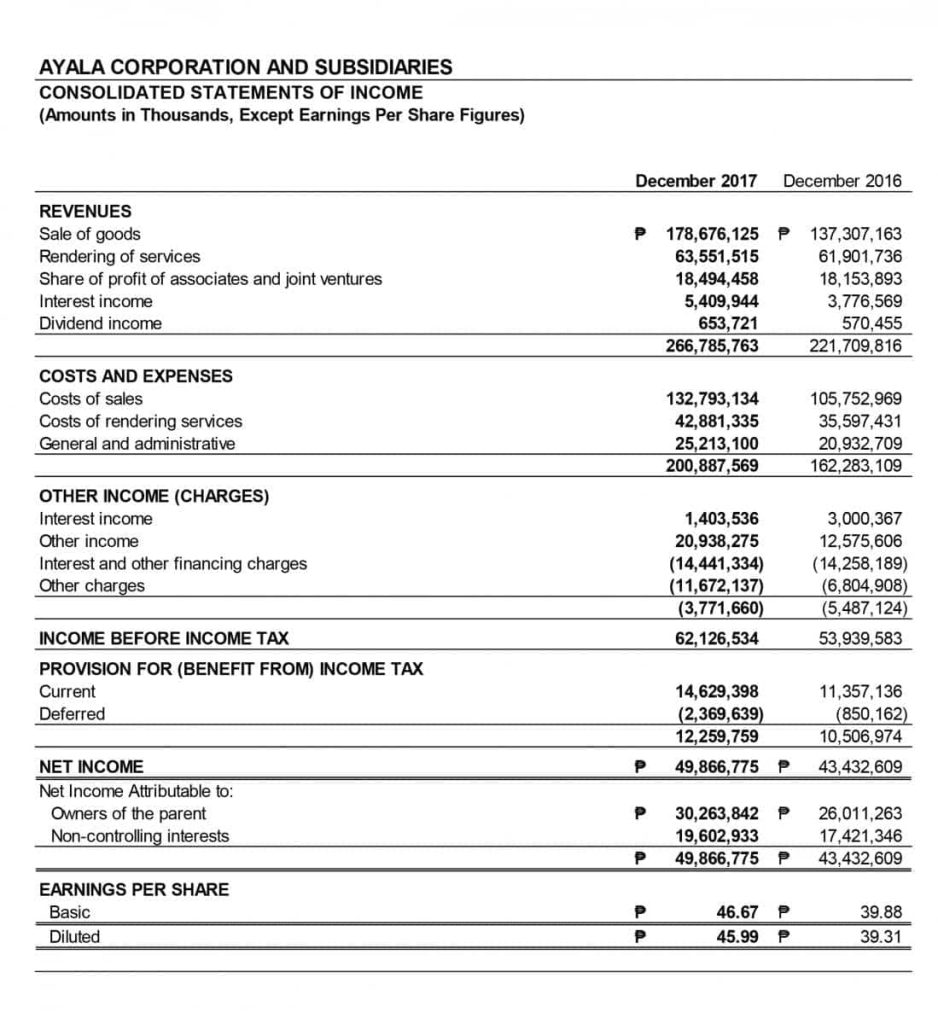
Ayala Corporation recorded a net income of ₱30.3 billion in 2017, climbing 16 percent from the previous year on the back of robust double-digit growth of its real estate and power businesses.


The positive results were buoyed by strong equity earnings contributions from Ayala’s business units, which reached ₱35.8 billion, 12 percent higher from a year ago. This was led by Ayala Land and AC Energy, whose equity earnings contributions expanded 21 percent and 30 percent, respectively.


“We are happy to see this earnings momentum sustained for the sixth consecutive year as the expansion strategy across our portfolio of businesses continues to bear fruit. Consistent double-digit growth since 2012 has translated to a compounded annual growth rate of 22 percent. We remain positive about our trajectory as we move closer to our 2020 goals,” Ayala Corporation President and COO Fernando Zobel de Ayala said.

Real Estate

The resurgence of property sales combined with a solid leasing business drove Ayala Land’s net earnings during the year, jumping 21 percent to ₱25.3 billion.


Revenues from property development, which includes residential and office-for-sale developments, as well as commercial lot sales, rose 23 percent to ₱101.5 billion on new bookings and project completion. Growth in reservation sales bounced back to double-digit levels during the year at 13 percent, reaching ₱122 billion.


Commercial leasing revenues, meanwhile, grew 10 percent to ₱31 billion driven by new mall openings, stabilized occupancy of office spaces, and the improved performance of its hotels and resorts portfolio.


Ayala Land’s strategy to rebalance its net income mix is increasingly taking shape. In terms of location, established estates (Makati, Nuvali, Bonifacio Global City, Alabang and Cebu) accounted for 54 percent, while new estates and growth centers made up for 46 percent of Ayala Land’s net earnings in 2017. In terms of business line, Ayala Land’s recurring income (mall and office leasing, hotels and resorts, and property management segments) accounted for 35 percent, while development income (property sales and construction) contributed 65 percent of Ayala Land’s net income during the year.


Ayala Land spent ₱91.4 billion in capital expenditure during the year. It launched 28 residential projects amounting to ₱88.8 billion. In leasing, it opened five new malls with 189,000 in gross leasable area, and six new offices with 185,000 in gross leasable area. In addition, it opened six new hotel and resort facilities, adding 556 rooms to its portfolio in 2017.

Banking

Bank of the Philippine Islands recorded a net income of ₱22.4 billion, up 1.7 percent from its year-ago level, as the absence of one-off gains tempered strong growth in its core banking business during the year. Excluding one-off gains from the sale of securities in 2016, net income grew 31 percent in 2017.

Total revenues rose seven percent to ₱71 billion as net interest income expanded 13 percent to ₱48 billion driven by asset growth and improvement in net interest margin. Non-interest income, meanwhile, dropped five percent to ₱22.9 billion on the absence of significant trading gains registered in 2016. This was partially offset by the bank’s higher fee-based income, which grew 16 percent to ₱19.9 billion, lifted by higher credit card fees, trust and investment management fees, insurance fees, bank commissions, and service charges.

BPI continues to be a leader in profitability metrics, with cost-to-income ratio at 54.3 percent, slightly higher from the 52.5 percent posted a year ago, mainly driven by its digitalization initiatives.

Total loans jumped 16 percent to ₱1.2 trillion, boosted by corporate loans. Asset quality improved with the gross 90-day non-performing loans ratio declining from 1.46 percent to 1.29 percent and reserve cover ratio increasing from 119 percent to 129 percent.

Last year, BPI announced the creation of a business banking segment, a new client group focused on the banking needs of the country’s small and medium scale enterprises. It also raised a record ₱12.2 billion from its offering of long-term negotiable certificates of time deposit, the largest issuance by far in the industry.

Last January, the bank announced a stock rights offering of up to ₱50 billion to support its strategic initiatives, including the strengthening of its market-leading businesses and core franchises through the expansion of lending activities across consumer, SME, and microfinance segments to capture positive momentum in the domestic economy. In addition, the stock rights offer will strengthen BPI’s capital base as it pursues its growth strategy in the medium term. Ayala has signified its participation in the rights offering.

Telco

Globe Telecom’s net earnings dropped five percent to ₱15.1 billion in 2017 due to higher operating expenses and depreciation charges as a result of increased investments in its data network.

Topline growth, however, remains strong, with service revenues reaching ₱127.9 billion during the year, up six percent year-on-year. This was fueled by sustained demand for data-related products. Mobile revenues grew seven percent to ₱98.5 billion. Globe’s mobile subscriber base reached 60.7 million at the end of 2017, three percent lower from a year ago. The decline in the cumulative mobile subscriber base was a result of the change in reporting Globe’s prepaid subscribers in 2017, which excluded prepaid subscribers who do not reload within 90 days of the second expiry period. Mobile data continues to drive Globe’s total mobile revenues, accounting for 44 percent from 38 percent a year ago.

Globe’s home broadband segment posted a seven percent increase in revenues to ₱15.6 billion in 2017. Total home broadband subscribers climbed 15 percent to 1.3 million year-on-year, putting Globe on track with its target to provide internet service to two million homes by 2020. Corporate data business increased four percent from a year ago to ₱10.3 billion owing to strong demand for data-driven solutions by corporates.

Globe’s consolidated EBITDA improved seven percent to ₱53.3 billion, while EBITDA margin stood at 42 percent from 41 percent in the previous year.

Globe spent around ₱42.5 billion in capital expenditure in 2017 to support its continuous network infrastructure enhancement. It launched new products to enable the Filipino digital lifestyle, including Mynt’s rollout of the GCash scan-to-pay system in malls, fastfood chains, major retailers, and convenience stores.

Water

Manila Water posted a muted net income growth of one percent to ₱6.2 billion as higher operating expenses and business development costs tempered topline growth during the year.

Revenues rose five percent to ₱18.5 billion, bolstered by strong revenue contributions from Laguna Water and Boracay Water, as well as higher supervision fees recognized by Estate Water balancing out flat revenue growth in the Manila Concession.

Operating expenses expanded 19 percent to ₱7.4 billion on higher overhead costs owing to Estate Water’s expansion, business development costs, and a one-time write-off of uncollectible accounts in Laguna Water.

Manila Water posted higher billed volume across all its business lines, with the non-Manila Concession posting strong double-digit billed volume growth. This brought total billed volume to 738.7 million cubic meters, three percent higher year-on-year. In the Manila Concession, the two percent-increase in billed volume helped offset the impact of tariff reduction.

Manila Water continues to intensify its infrastructure build-up with a 48 percent expansion in capital expenditures. Last year, the Manila Concession completed the Marikina North Sewerage Treatment Plant, while the Pasig North and South System Project is scheduled for completion in November 2019. Both projects have a capacity of 100 million liters per day.

Further, Manila Water received a notice of award from the City of Ilagan Water District to establish a joint venture for a bulk water supply and septage management company. Manila Water also received a notice of award from the Leyte Metropolitan Water District to establish a joint venture for a concession company. As part of its ongoing expansion in Southeast Asia, Manila Water is establishing a footprint in Thailand with the signing of a share purchase agreement in February to acquire an 18.72 percent stake in Eastern Water Resources Development and Management Public Company Limited, a publicly-listed water supply and distribution company in Thailand.

Power

AC Energy’s net earnings jumped 31 percent to ₱3.5 billion in 2017, primarily driven by fresh equity earnings contribution from its geothermal platform, and boosted by solid contributions from its wind energy assets.

A strong wind regime bolstered the better performance of NorthWind and North Luzon Renewables during the year. Services income derived from the financial close of a new power plant likewise contributed to AC Energy’s net earnings.

AC Energy continues to execute on its diversification strategy. Following the acquisition of Salak and Darajat Geothermal in Indonesia in early 2017, AC Energy is assembling a portfolio of renewable energy assets in Southeast Asia. It is developing a 75 megawatt wind project in Sidrap, Indonesia, which is expected to come online in the first quarter of 2018.

Last January, AC Energy, in partnership with BIM Group of Vietnam, agreed to jointly develop over 300 megawatts of solar power projects in Ninh Thuan province, Vietnam. The initial 30 megawatts of the solar project broke ground, with investment for this phase expected to reach 800 billion VND and to be completed within the year. The solar project is envisioned to be expanded by an additional 300 megawatts.

Similarly, AC Energy is boosting its conventional energy portfolio. Last December, the project financing for the second unit of its 2 x 668 MW super-critical coal fired power plant in Bataan, GNPower Dinginin, achieved financial close. AC Energy has approximately 50 percent economic stake in the project, which has an estimated cost of US$1.7 billion. The project will support the increasing electricity demand of Luzon and Visayas. Construction of the first unit is well underway, and is targeted for commercial operations by 2019, with the second unit scheduled for completion by 2020.

Industrial Technologies

AC Industrials registered a net income of ₱1.2 billion, up four percent from its year-ago level, on better performance of both its electronics manufacturing and vehicle retail units.

IMI’s net earnings expanded 21 percent to US$34 million on the back of solid revenue growth, which exceeded the US$1 billion mark during the year. This topline growth was driven by contribution from recent acquisitions and sustained growth in the automotive and industrial markets.

Last February, IMI successfully completed its ₱4.998 billion rights offer with the issue of 350 million common shares to existing shareholders. AC Industrials, which previously held 50.6 percent of IMI’s outstanding shares, subscribed to its proportionate share, as well as any unsubscribed rights shares. This raised its stake in IMI to 52 percent. Proceeds of the rights offer will be used to fund IMI’s capital expenditure program and for debt refinancing.

Meanwhile, revenues from AC Automotive expanded 37 percent to ₱31.2 billion, boosted by strong sales across all brands—Honda, Isuzu, Volkswagen, and KTM.


AC Industrials continues to ramp up its portfolio in global and domestic industrial technologies by capitalizing on opportunities arising from disruptive technological shifts, changing industry landscapes, and increasing demand from end-users. Last month, AC Industrials acquired a controlling stake in Merlin Solar Technologies Inc., with an ownership interest of 78.2 percent after the close of the transaction and completion of other related activities. Merlin is an emerging company that is developing differentiated solar solutions resulting in products with high durability, flexibility, and increased solar power output, allowing for potentially innovative applications in areas with demanding environments, such as transportation and infrastructure. Headquartered in San Jose, California, Merlin currently has additional manufacturing facilities in Thailand.

Infrastructure

As it executes on the three public-private partnership projects in its portfolio, AC Infrastructure is pursuing opportunities to expand its portfolio in the transport and infrastructure network space.

Last February, as part of a consortium, AC Infra submitted an unsolicited proposal for the rehabilitation, upgrade, expansion, operation, and maintenance of the Ninoy Aquino International Airport.

In the same month, AC Infra signed an agreement to invest in a company that will engage in the provision of fulfillment solutions services. AC Infra will own a stake of up to 60 percent, while the remaining 40 percent will be held by ZALORA affiliate, Brillant 1257 GmbH & Co. Vierte Verwaltungs Kg, which is based in Germany. This investment forms part of Ayala’s strategy to develop infrastructure that will result in better efficiencies and improve the fulfillment processes of its existing businesses in real estate, banking, telecommunications, and e-commerce.

Education

Ayala is ramping up its investments in the education space. In January 2018, it announced that it had signed a non-binding term sheet for a potential merger with iPeople Inc., the listed holding company for the education sector of the Yuchengco-led House of Investments. The potential merger would include iPeople and its subsidiary, Malayan Education System, which operates Mapua University, Malayan Colleges Laguna, and Malayan Colleges Mindanao, with a combined population of approximately 17,000 students. Mapua is one of the leading private engineering and technical universities in the country, with the most number of Commission on Higher Education-recognized Centers of Excellence in Engineering. It has also obtained a world ranking as a QS-3 Star university.

The potential merger would also include AC Education’s subsidiaries, the University of Nueva Caceres, one of the oldest and largest universities in Bicol with over 8,000 students, and APEC Schools, the largest stand-alone chain of private high schools in the country with over 16,000 students.

In February 2018, AC Education executed a share purchase agreement for the acquisition of approximately 96 percent of National Teachers College, which would also be included in the potential merger. With approximately 10,000 students, Manila-based NTC would complement the offerings of AC Education and iPeople.

Healthcare

AC Health continues to scale up its platforms in retail pharmacy and primary care. Generika, its retail network of affordable quality generic medicines, recorded ₱3.3 billion in revenues, up 15 percent from a year ago on higher retail sales and store expansion. It opened 100 stores in 2017, bringing total store count to 750. AC Health is targeting to ramp up Generika’s total store count to 850 by the end of 2018.

Generika was awarded the first ASEAN Inclusive Business Award, a new category introduced during the 10th ASEAN Business Awards held in 2017. This award recognizes innovative business models in the region that create concrete social impact by providing underserved communities with access to basic services and income opportunities. The ASEAN Business Awards was launched by the ASEAN Business Advisory Council in 2007 to recognize companies that contributed to the growth and prosperity of the ASEAN economy.

Meanwhile, FamilyDOC, AC Health’s chain of community-based primary care clinics, now operates 25 clinics, serving over 85,000 unique patients from its current locations in Cavite, Laguna, Las Piñas, Parañaque, Taguig, Pateros, Pasig, and Quezon City. AC Health targets to open 33 new FamilyDOC clinics in 2018.

Capital Expenditure

The Ayala group is increasing its capital expenditures this year by 44 percent to ₱249 billion, largely to support the parent’s own investment program as well as the growth strategies of Ayala Land, Globe, and Manila Water.

At the parent level, Ayala has earmarked ₱51.8 billion in capital spending this year, primarily to fund its subscription to BPI’s stock rights offering and its investments in AC Energy, AC Industrials, AC Education, and AC Health.

Balance Sheet

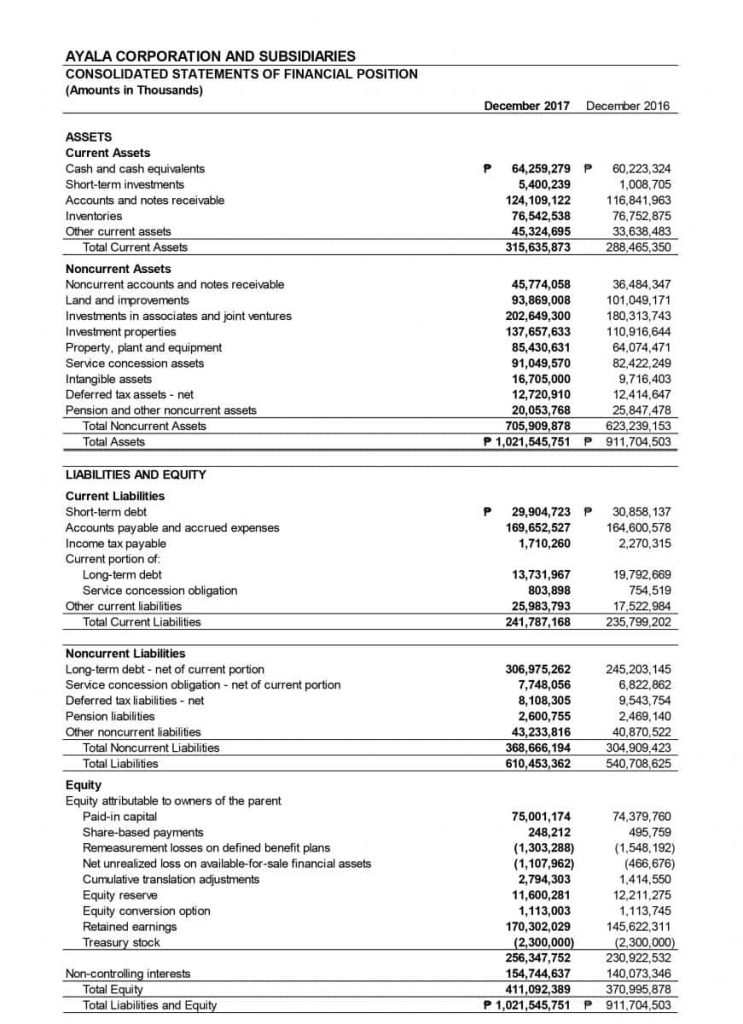
Ayala’s balance sheet remains at a comfortable level. At the parent level, cash amounted to ₱18.6 billion while debt stood at ₱83.3 billion at the end of 2017. Net debt-to-equity ratio during the period was 0.59 at the parent level and 0.69 at the consolidated level. Ayala’s loan-to-value ratio, the ratio of its parent net debt to the total value of its investments, stood at 6.4 percent at the end of 2017. Consolidated assets of the Ayala group stood at ₱1.02 trillion, 12 percent higher from the previous year.


In September last year, Ayala issued US$400 million senior perpetual bonds with an annual coupon rate of 5.125 percent with no reset nor step-up, a first in the Philippines. The issuance allows Ayala to optimize its average cost of funding, extend its debt maturity profile, and diversify its funding source.

Ayala Net Income in 2017

Ayala Net Income in 2017

JAZA’s Acceptance Speech on Being Awarded The Metrobank Professorial Chair for Public Service & Governance

JAZA's Acceptance Speech

Fr. Jet Villarin, President of the Ateneo de Manila University, and an old friend, thank you for leading the way with your opening remarks. Dr. Tonette Palma-Angeles, Vice President of the Ateneo Professional Schools, another old friend, always a pleasure to be back at the Ateneo.

The Deans of the Ateneo Professional Schools, Dean Rudy Ang of the Ateneo School of Business, Dean Ronaldo Mendoza of the Ateneo School of Government, and Dean Manolet Dayrit of the Ateneo School of Medicine and Public Health, this year’s host for the Professorial Chair, Mr. Chito Sobrepeña, President of the Metrobank Foundation, thank you for your opening message – it was wonderful to hear about the great work you do at the foundation.

To the Executives of the Metrobank Group of Companies, the Metrobank Foundation, and the Manila Doctors Hospital, thank you for being here today.


I would also like to make special mention of Dr. Alran Bengzon, former secretary of health and founder of the Ateneo School of Medicine and Public Health, and with whom we share similar passions with, as well as Ted Ferrer, a long-time Ayala executive, but more importantly the founder of and our partner at Generika.


I am honored and humbled to be here today to receive the Metrobank Foundation Professorial Chair Award for Public Service & Governance. I would like to thank especially, Dean Manolet Dayrit, and the Ateneo School of Medicine and Public Health, who, as this year’s hosts, have graciously chosen us for our work in healthcare. As many of you may know, healthcare is fairly new to the Ayala Group, and so to receive this recognition early on, is, to us, a wonderful affirmation. I am delighted to be here today to speak about our approach to healthcare, and the innovations we are introducing to improve healthcare for more Filipinos. It still comes as a surprise to many that Ayala’s first venture into healthcare can be traced back to our earliest days, when, in 1834, Johann Andreas Zobel, set-up “La Drogueria y Botica de Zobel,”in Intramuros. The drugstore survived for over a hundred years, but eventually closed during the second World War.


Fast forward to 2015, we would eventually return to healthcare, and once again in the retail pharmacy space, with the establishment of AC Health, and its partnership with Generika Drugstore. Today, our portfolio includes a chain of clinics, called FamilyDOC, and various health technology solutions, such as an online pharmacy start-up called MedGrocer.


It is important to note that our return to healthcare was not by chance. It was a result of a deliberate exercise in innovation, something which we have embedded into our thinking at the Ayala Group. Allow me to begin by briefly touching on our view on innovation in the Ayala Group, since it is the same mindset that has shaped our approach to healthcare.

At the Ayala Group, we pride ourselves in having a long history of reinvention and disruption across the many industries we are present in. Innovation has been key to our success and longevity as a business.
We see potential in new businesses and industries, continuously reinventing our portfolio to remain relevant to the changing times. But beyond just portfolio building, we have made a concerted effort to invest in businesses that improve people’s lives. Our goal is to make businesses better by filling in existing gaps or serving unmet needs. Ultimately, we have a fundamental belief in the concept of shared value – that businesses have a unique role in social development, and that shared value can only truly be achieved when one builds social impact into the very fabric of one’s businesses.


To us, that is the most powerful type of innovation – building businesses that address social needs and improve lives. This is what we call “Inclusive Innovation.”


Let me share three examples from across the Ayala Group to illustrate our approach to this kind of innovation, starting with our experience in Manila Water.


Few of you might still recall the terrible water situation we had in Metro Manila back in the 1990’s. The water crisis was even more pronounced in low-income communities. Back then, people would queue in long lines twice a day to buy their water in pails, at 40 pesos per cubic meter, or a total cost of up to 1,500 pesos per month.


In response, Manila Water pioneered what we called the Tubig Para sa Barangay program, an innovative approach of working with low-income communities to ensure that they could have proper access to affordable water. The program introduced flexible financing options, socialized tariff schemes, and more importantly, engaged community members as partners in the program.


Today, participants in our program enjoy clean and potable water from their own homes with significant cost-savings, paying only 9.47 pesos per cubic meter, which is an average of only 165 pesos per month. More importantly, we have achieved 100% collection efficiency in the program’s communities, water-borne diseases in their areas have been reduced, and the overall sanitation conditions have greatly improved.


Let me share with you an example of this innovation mindset in our education business. A few years ago, we were looking at the educational sector and noted the massive dropout rates across all educational levels. I was astonished with the numbers: out of those who enter Grade 1, only 29% get to enter college, with only 21% eventually graduating. Among these graduates, only 9% are considered employable.


To address these critical gaps, our team brainstormed on various possible ideas, one of which was the concept behind APEC Schools. APEC Schools, which stands for “Affordable Private Education Centers,” aim to address the lack of access to quality, affordable education, particularly in the high school level.


APEC’s learning modules focus on enhancing employability, and cultivating life skills. The modules build industry-specific knowledge, but also focus on IT proficiency, business communication skills, and critical thinking, to name a few. Very importantly, it also provides its students with valuable soft skills and work habits, such as self-confidence, grit, and persistence. Today, APEC has over 16,000 students across 23 sites in Mega-Manila.

As a final example, let me share with you our experience with Mynt, our fintech joint venture with Globe and Ant Financial. The Philippines remains largely unbanked. We still live in a society where 70% of Filipinos do not have a bank account. In fact, 1 out of 3 LGUs is considered unbanked.


But with mobile penetration at 117% and a population that was very adept with mobile technology, we saw an opportunity to provide mobile payment and lending solutions to unbanked and underserved Filipinos.
Mynt’s GCash is a micropayment service that transforms a mobile phone into a virtual wallet, which can be used to buy prepaid load, pay bills, send money, and shop online. Its lending company, Fuse Lending, offers personal and business loans, using innovative credit scoring methods.


Mynt now has the biggest mobile money base in the country, with more than 3 million registered customers, 12,000 partner outlets and facilities, and ~₱1 billion in transaction value per week. And with Ant Financial now as our strategic partner, we see great potential in expanding these services to millions of Filipinos.


These are just some examples of how we have developed new ideas to address gaps and social needs. In a similar way, we view healthcare as an industry that is ripe for disruption and reinvention, with great potential for more inclusive innovation.


Globally, countries have struggled with how to provide better healthcare at lower costs, amidst evolving market demands. Healthcare systems around the world must grapple with shifts to an aging population, a growing number of chronic diseases, and greater demand for patient-centered care. The United Nations estimates that, between 2015-2030, there will be a 56% increase in the elderly population. In addition, disease profiles have shifted, from predominantly acute infectious diseases, to chronic lifestyle-related diseases. According to the World Health Organization, non-communicable diseases, such as hypertension and diabetes, account for 70% of all deaths globally. On top of these demographic shifts, consumer mindset is also changing – patients want to be more empowered about their health, and are demanding more convenience and accessibility.


In response to these trends, we now see a lot of disruptive innovation happening in healthcare globally. First, we are already seeing the emerging disruption of traditional business models in a major effort to bring down the cost of care and create better synergies. In 2017, CVS Pharmacy and Aetna announced a merger that would combine the largest pharmacy retailer in the US, with a leading health insurance provider, seeking to integrate pharmacy and financing capabilities, with direct further access to consumers. Meanwhile, just a month ago, Amazon, Berkshire Hathaway, and JP Morgan announced a partnership to set-up a healthcare company that would provide more cost-effective services for its workforce of over a million employees. The combined scale and expertise of these partners, hints at the potential to build technology-enabled solutions to address rising healthcare costs in the US.


Another area of disruptive innovation I foresee, will come with new technologies and discoveries in the field of gene sequencing and DNA testing. I am fascinated with how gene therapy has ushered in a new era of personalized medicine, where screening can identify genetic predispositions and treatment can be customized down to the molecular level. Last month, doctors at the University of Pennsylvania announced that they will soon begin human trials utilizing gene editing technology, called CRISPR, to treat certain cancers. The treatment will consist of editing DNA from a patient’s immune cells so that they are able to recognize and fight off cancer cells. The same technology can potentially be used to treat thousands of genetic diseases, many of which are incurable today. And while much is still unknown or controversial in the field of genetics, imagine the possibilities that this technology could unlock in the future, allowing us to battle, and win over, diseases we barely understand today.


In the Philippines, we also believe the healthcare system is ripe for disruption. Admittedly, we are grappling with our own healthcare issues as a country, but our issues are far more fundamental. Access to affordable, quality healthcare is a basic gap that unfortunately persists today. At the Ayala Group, we are cognizant of these gaps, and have made a commitment to invest in healthcare to help address these gaps.


Healthcare is important to us at the Ayala Group for several reasons. First, we recognize that healthcare is an integral part of the national agenda. We share the view that healthcare is not only a component for progress, but a fundamental right for all, as our good friend Dr. Alran Bengzon says. Second, as our economy improves, we see increasing demand and awareness of healthcare products and services, especially with the growing middle class. Third, and perhaps most compelling, is that across a Filipino patient’s life cycle, there is a clear need for improved healthcare. From birth to death, from cradle to grave, Filipinos struggle with poor health outcomes. The Department of Health estimates that on average, 60 infants die per day. A study conducted by The Economist, ranks the Philippines as the 78th out of 80 countries in terms of Quality of Death. It is evident that there is much room to improve the way healthcare is delivered today.


At AC Health, we believe we can improve healthcare by building an integrated healthcare ecosystem across the continuum of care, with retail health services at the forefront, creating affordable, last-mile access to millions of Filipinos. We envision over 1000 Generika pharmacies, 100 FamilyDOC clinics, and strategic partnerships with hospitals and specialty centers, tied together by innovative technology, to create a seamless experience and an integrated network. Most importantly, we keep our patients at the heart of everything that we do.


We believe the private sector plays an important role in improving healthcare, collaborating amongst each other, filling gaps, developing new innovations, and offering services that are complementary to what the public sector can provide.


Let me give you a few examples.


First, the private sector, with its access to capital and speed to market, can fill in the gaps in the industry and streamline processes. As an example, we are building FamilyDOC community clinics all around greater Metro Manila to help address the need for primary care. FamilyDoc clinics are a 3-in-1 retail model, consisting of a pharmacy, laboratory services, and primary care consultations. These services are offered at affordable price points, and more importantly, at convenient locations near residential communities. By the end of this year, we will have over 50 clinics, employing 120 primary care physicians, and over 200 allied health professionals.
With FamilyDOC, we hope to bridge the gap for affordable and quality primary care, specifically in middle-class communities where health facilities and medical professionals may not be easily accessible.


Meanwhile, Generika Drugstore, through its network of over 750 pharmacies nationwide, offers access to quality generic medicines, with up to 85% savings versus branded equivalents. I am astounded that our medicine at times still costs 30 times more than other countries.


I am proud to say that Generika was recently recognized by the ASEAN Business Awards as the first recipient of the new Inclusive Business Award. Generika bested 28 other companies from all over the ASEAN region, and was recognized for its inclusive business model, which pioneered the retail of quality generic medicines in the Philippines.


In continued partnership with our good friend Ted Ferrer and his family, we hope to deliver more affordable medicine to many more Filipinos, and promote the importance of over-all health and wellness more broadly.
Second, the private sector can encourage innovation and new technologies to deliver better healthcare. We have several examples of health technology at the Ayala Group. Through Globe’s KonsultaMD, users get 24/7 access to a licensed doctor through their mobile phones. In the pharmacy retail space, MedGrocer is creating a convenient channel through its online platform and delivery of medicine. AC Health has also developed its own in-house Electronic Medical Records and Clinical Information System, which allows us to utilize real-time data to improve efficiency and patient care at our FamilyDoc clinics. More importantly, it also enables us to perform extensive data analytics for population health, allowing us to monitor health outcomes, incidence rates, and disease trends at the community level. Apart from our Electronic Medical Records, FamilyDoc also utilizes tele-radiology, through a 3rd-party provider called LifeTrack. Through Lifetrack’s platform, clinics are able to digitally send x-ray and ultrasound images to Lifetrack’s pool of certified radiologists, who are then able to give an official reading in as little as 15 minutes. These health technology solutions not only improve efficiency and provide cost-savings, they also expand the reach of services, enable integration, and improve quality of care.


Before I end, I just wanted to reiterate an important point. The work that we do in healthcare is about improving lives. Ultimately, healthcare is about people. And while we are still in the very early stages of our healthcare business, I am encouraged with the many stories we have already begun to see, where you can really feel the impact one can have on our customers and patients.


Allow me to share with you a story from one of our patients, Lola Nina, an 86-year old senior from Taguig, where, thankfully, we have built one of our FamilyDOC primary care clinics. A few months ago, Lola Nina’s blood pressure shot up to dangerous levels, which could not be brought down by her usual medicines. Rather than going on an hour-long trip to her usual healthcare facility, she visited our FamilyDOC clinic, which was a few minutes from her home. She was assessed by our doctors, and her blood pressure was controlled with medication. But beyond simply controlling her symptoms, her doctor took the time to do a comprehensive assessment, which revealed an underlying Urinary Tract Infection as a trigger to her increased blood pressure.


I am proud to say Lola Nina is now well and comes in regularly for her blood pressure monitoring. She feels stronger, and is able to spend more time with family and friends, even going back to her weekly ballroom dancing, after five years of not doing so. She has also become one of our brand ambassadors, bringing in family, and fellow seniors to our clinics.


I like Lola Nina’s story, because, while it certainly illustrates the importance of quality accessible health care services, it also demonstrates the transformative effect that primary healthcare can have. Improving healthcare is not just about the body, medicine or disease – it is also about enabling people to live their lives better.


In closing, I would like to advocate for a collaborative approach between the public and private sector towards the common goal of improving healthcare for all.
For the private sector, we encourage more participation and partnerships among stakeholders to help fill in the gaps in the market, and to continue to invest in innovation, whether in the form of products, services or business models.


For the government and public sector, I would encourage regulatory frameworks that promote expansion of reach and services to many more Filipinos. In particular, we look forward to further improvements in government healthcare financing through PhilHealth, including packages to promote primary care benefits. I am delighted to learn that, as of 2016, PhilHealth now covers 91% of the population. With such a large member base, PhilHealth can serve as an excellent platform to improve financial accessibility. I believe we need to continue increasing awareness of benefits, so that more Filipinos understand, and avail of, the range of services that are now accessible through PhilHealth. We also encourage the creation of programs, funding, and incentives that can hopefully increase both the supply of medical professionals and healthcare facilities. Finally, we look forward to policy and regulation that can enable and encourage the development of new health technology services to reach a broader base of the population.


We believe the challenges of healthcare cannot be met by a single sector alone – we need the engagement of multiple stakeholders to ensure that we are protecting the fundamental right of all Filipinos to receive the healthcare they need and deserve.


I would like to take this opportunity to thank the Metrobank Foundation, and the Ateneo Professional Schools, for organizing this event, and for their commitment to ensure the continuity of the Professorial Chair though the years. I believe this can serve as an excellent vehicle to promote greater collaboration among the different groups present here today. Know that we, at Ayala, share your dedication to building a stronger culture of public service and good governance, not only in healthcare, but across the entire Ayala group.


Thank you, and a pleasant morning to all.

-Jaime Augusto Zobel de Ayala

 Chairman and CEO

 Ayala Corporation

View Gallery

AC Education Acquires National Teachers College

AC Education, Inc. (“AEI”), the wholly-owned education arm of Ayala Corporation, was selected as the winning bidder of the tender process conducted for the sale of shares of National Teachers College (“NTC”). A Share Purchase Agreement for approximately 96% of NTC’s shares has been executed by the parties. The acquisition remains subject to certain closing conditions, including securing the necessary regulatory approvals.


NTC is located on Nepomuceno Street, Quiapo, Manila and was founded in 1928, as the first school in the country to offer General Education leading to a Bachelor of Science in Education. It has a long track record of commitment to excellence in teaching, growth and inclusion, with almost 10,000 students from Basic to Higher education. It is one of the most well-recognized teacher education institutions in the country, with Level III Accreditation from PACUCOA for its Bachelor programs in Elementary and Secondary Education, and over 3,500 Education students in both college and graduate programs. NTC has also established growing Colleges of Accountancy & Business, Arts & Science, Hospitality Management and Information Technology, and a School of Advanced Studies.


Ayala Corporation started investing in the education sector in 2012 through AC Education, with a vision of delivering affordable and quality education that leverages an industry-based, experiential and technology-enabled approach, to significantly improve the employability of its high school and college graduates. AC Education’s Professional Employment Program (PEP) has significantly increased the employability and starting salaries of its college and senior high graduates.


In Basic Education, AEI has built the largest chain of stand-alone, private high schools in the country, APEC (“Affordable Private Education Center”) Schools, with approximately 16,000 students in 23 sites in Metro Manila, Cavite, Rizal and Batangas. In Higher Education, AC Education has invested in the University of Nueva Caceres (“UNC”) located in Naga City, with approximately 8,000 students. It is the oldest and one of the largest private schools in the Bicol region, offering college programs in Engineering and Architecture, Business and Accountancy, Education, Computer Studies, Law, Arts & Sciences, Criminology, Nursing and Graduate Studies. Together with NTC, the combined population of AC Education’s schools is approximately 34,000 students.


“We are very grateful that several groups had expressed their sincere interest in continuing the legacy of National Teachers College as established by our forebears. In selecting the buyer who shall acquire the shares of NTC, it was important to look not only at the capability to expand the school’s horizons, but also at the alignment of values and vision for raising our Filipino youth to be excellent teachers, industry leaders, or capable, competent individuals, in whatever path they may choose. We look forward to working with AC Education in this transition process and in moving NTC closer to becoming the world-class institution it was intended to be. We are honored to pass on the torch to AC Education, which we are confident will remain committed to building on the ideals upon which NTC was founded,” said Atty. Rolando De Castro, Chairman of the Board of The National Teachers College.


“The Ayala Group is committed to investing in the Education sector because we recognize that it is critical to building our nation. We believe that NTC can play an integral role in our efforts to contribute to a better education system in the Philippines, because of NTC’s long and successful track record in producing quality educators who go on to teach in both public and private schools,” said Mr. Jaime Augusto Zobel de Ayala, Chairman and CEO of Ayala Corporation.


“Our goal is to fulfill the vision of NTC’s founders of ‘…quality education for teacher preparation and development of manpower skills, anchored on the ideals of Excellence, Relevance, Access and Effectiveness, geared towards national productivity and world class competitiveness.’ We are committed to investing in further quality at NTC, and building on its traditions of excellence and inclusiveness,” said Mr. Alfredo I. Ayala, CEO of AC Education.


Mr. Ayala added, “We believe that NTC will be a key strategic element in the merger we have proposed between AC Education and iPeople.” Last month, AC Education and iPeople announced that they had executed a Non-Binding Term Sheet for their potential merger. iPeople is the listed education arm of House of Investments Inc., a member of the Yuchengco Group of Companies. Together with APEC Schools and UNC, NTC would be part of the assets that AC Education would contribute to its potential merger with iPeople, the parent of Mapua University, Malayan Colleges Laguna and Malayan Colleges Mindanao.

BPI Capital Corporation acted as the financial advisor of AC Education for the acquisition.

JAZA’s New Year Message to the Ayala Group

To expand access of reading JAZA’s New Year Message for Ayala group employees, we are publishing the material below.

Dear colleagues and friends,

Welcome to the start of 2018 and I hope you have all had the chance to get some rest in the company of family and friends. A big thank you, upfront, for working to ensure the continued growth and relevance of the Ayala group.

I write this note as part of a new tradition that I wanted to implement this year.  So many events happen in any given year and there is never much time to synthesize and bring some coherence and closure to all these thoughts.  Today is an attempt, on my part, to try to look back at the year that passed and identify some key themes in the hope of both bringing closure to my thoughts and setting some values based goals for the year ahead.  These thoughts will remain broad, macro focused and cover both global and national themes that are relevant to us.  Here goes.

As we reflect on the past twelve months, we see trends that persist – both social and economic – that affect many sectors of society.   We are increasingly globally interconnected and many of these themes cut across nation states.  I believe that it is important for us to take stock of these key trends, and understand how they shape and influence our path forward both as professionals and as stewards of our institutions.

Let me draw attention today to five themes that are the most relevant and that have had a disproportionate impact on our societies in 2017.

First, let me touch on the rise of populism which has been driven, to a large extent, by both perceived and real increasing social and economic inequity. Second, let me expand on the intertwined themes of globalization and technological advancement, two trends that have been at the center of public debate but whose effects have been, in my opinion, misunderstood.  Third, let me emphasize our need to continue to retool and upgrade our workforce in order to successfully navigate the employment challenges brought about by technological advancements and to remain relevant to the changing nature of our industries. Fourth, the need for infrastructure to support our many social and economic requirements remains of unprecedented importance.  Finally, let me highlight the indispensable role that the private sector plays in defining and executing on a more comprehensive economic social contract, where businesses build trust and relevance by being contributors to society and not just contributors to a more limited grouping of stakeholders.

VIEW MORE

Download: JAZA-New-Year-Message-to-the-Ayala-Group.pdf

Fostering CSR in the Philippines: Conference on Responsible Business

JAIME AUGUSTO ZOBEL DE AYALA
Fostering CSR in the Philippines: Conference on Responsible Business

Session 1: The Role of Businesses in Achieving the Philippines’ Goals for
Sustainable Development | Opening Statement
January 17, 2017

Good morning, and thank you for the kind invitation to be here today.

The past few years have seen questions raised around the role of business in inclusive growth and sustainable development. Brexit, the rise of populism, the election of unorthodox leaders around the world have all
been traced to a dissatisfaction with the status quo—with societies where progress has not benefited all, and lack of economic opportunity.

Businesses are now being asked to do more, to involve themselves more in combating developmental hurdles, and build a more all-encompassing relationship with society. Ignoring the challenges faced by both global and national communities today threatens our ability to create long-term value and jeopardizes both enterprises and the markets we serve.

On a personal note, the role of business in inclusive growth and society has always been in my thoughts. I remember completing my MBA and thinking that, while the knowledge I gained was valuable, it was not necessarily sufficient to help our country overcome the challenges it faced. In the Philippines, our need to address economic inclusivity and build on sustainable business practices remains of paramount importance. Allow
me to share with you some of our experience at the Ayala group.

The Ayala group has always aligned its business strategies with the country’s development agenda. Throughout our history, we entered critical sectors in dire need of private sector participation. In recent years, we have become much more aware of integrating societal challenges into the core of our business strategy. We reinvented some of our business models and created new ones to broaden our positive impact on the
communities where we operate and the country at large. Through our businesses, we do our best to engage society in a deeper and more meaningful way.

Most of our businesses traditionally catered to the higher end of the market. In recent years, we have expanded our products and services to reach a wider segment of the population. Ayala Land now offers affordable housing for as low as P500,000, while Globe Telecom provides affordable subscription plans for mobile and internet. Meanwhile, BPI has also made it a point to create customized loan products and provide financial guidance to the micro- and small entrepreneur segment. In addition, Manila Water delivers water supply as well as sewerage and sanitation services to more than 6 million customers in the eastern part of Metro Manila. It  as a flagship program called Tubig Para Sa Barangay, which is designed specifically for areas with clusters of low-income communities, including informal settlers.

Moreover, we entered the energy, infrastructure, health, education, and industrial technologies spaces. These are all sectors with critical gaps in quality and affordability, and are crucial in sustaining our country’s growth and development. Through AC Energy and AC Infrastructure, we are helping build our country’s much-needed physical infrastructure. Through AC Health and AC Education, we are able to provide affordable, quality services that supports human capital development.

Human capital development, particularly in skills training and education, is something we have identified to be absolutely necessary today, and it is an endeavor in which the private sector can contribute significantly. Businesses are in an excellent position to identify the disruptive impact on new technologies, as well as the new skills that will be necessary to adapt. We are already taking steps in this direction. Through APEC schools, AC Education uses a specially-designed curriculum to enhance the employability of students with skills needed in the job market. A number of other companies have their own initiatives to ensure the continued learning and development of their employees, keeping them up to industry standard—Globe University, IMI University, and Makati Development Corporation’s partnership with TESDA to upskill its construction workforce.

These are only a few examples of how Ayala is responding to the call of the times—how we remain progressive contributors to the changes needed in the world, and how we are evolving to make sure that we do
our part in national development.

The United Nations Sustainable Development goals were instrumental as we made a deliberate shift in company strategy. We can all agree that the SDGs are the simplest, clearest articulation of the goals we all share: the eradication of poverty, and the flourishing of communities, industry, innovation, and the environment.

The SDGs provided our group with a framework through which we could shape our value creation process—clear outcomes by which we could frame our sustainability goals. Framing our value creation process along the SDGs allows us to align with global initiatives.

Given the diversity of the industries in which Ayala is present, our group of companies contributes to the SDGs in a wide variety of ways.

Social tensions around the world have put at the forefront of our considerations the paramount role that the private sector plays in providing decent livelihood and work. Apart from the millions in capital expenditures that Ayala invests into the domestic economy, the group also contributes to “decent work and economic growth,” through the jobs it generates. The Ayala group provided employment opportunities to over 124,000 individuals in 2016. Moreover, as of November 2017, Ayala Land’s construction arm, Makati Development Corporation, provided close to 70,000 jobs in the lower-income segment, particularly for skilled construction workers. MDC has also partnered with TESDA in response to the industry-wide shortage in skilled labor and provide employment opportunities for more individuals in the construction industry.

In terms of “sustainable cities and communities,” Ayala Land has distinguished itself through its sustainable estates in the country that consider disaster resilience, connectivity, eco-efficiency, and economic development. For “clean water and sanitation,” Manila Water delivers a clean, reliable supply of water, sewerage, and sanitation services to over six million customers.

To complement these efforts, Ayala adopted the Integrated Reporting framework. This allows us to hold ourselves to higher standards of transparency and accountability by discussing not only financial and operational highlights, but also our sustainability and inclusive development initiatives documented through the SDGs. The Ayala Corporation 2016 Integrated Report was the first Integrated Report published by a Filipino company.

Ensuring that our companies can contribute to societal growth, I believe, is both a moral and a practical imperative. This is not mere altruism; rather, it is a deliberate strategy. Businesses cannot survive in societies where
inequity thrives; in markets failing markets; and where the environment is socially and physically degraded. Tremendous value can be realized when we strive to build more inclusive businesses—not only can companies
harness innovation and creativity in going beyond traditional models, we also help to empower the markets that have sustained our businesses.

Thank you, and I look forward to a productive and meaningful discussion.

Download: JAZA – CSR Conference 2017 Opening Statement.pdf

Joint Press Statement by the House of Investments and Ayala Corporation Regarding the Proposed Merger of Their Education Groups

iPeople Logo
Ayala Corporation Logo
House of Investments Logo

iPeople, inc. (“iPeople”), the listed holding company for the education sector of House of Investments Inc., a member of the Yuchengco Group of Companies, and AC Education, Inc. (“AEI”), the wholly-owned education arm of Ayala Corporation, have executed a Non-Binding term sheet for their potential merger. Under the Non-Binding term sheet, the parties agreed to an exclusivity period to complete due diligence, and to finalize the terms and conditions of the proposed merger within the first quarter of 2018. All terms and conditions of the proposed merger, including the involvement of House of Investments and Ayala Corporation in the management of the surviving entity, iPeople, shall be presented for approval by the parties’ respective boards of directors and merging parties’ stockholders, and the transaction will be subject to the requisite regulatory approvals as well.

The potential merger would bring together the educational institutions of House of Investments and Ayala Corporation (iPeople and AEI respectively). The potential merger would include iPeople and its significant subsidiary, Malayan Education System, Inc. (Operating under the name of Mapua University), a leading private engineering and technical university in the country, a world ranked QS-3 star university and the school with the most CHED Centers of Excellence in Engineering, and its subsidiaries, Malayan Colleges Laguna, the best board exam performing private school in Calabarzon, and Malayan Colleges Mindanao, and AEI and its subsidiaries, the University of Nueva Caceres, one of the oldest and largest universities in Bicol, and APEC Schools, the largest stand-alone chain of private high schools in the country. Together, the combined population would be over 40,000 students.

“We are looking forward to this potential merger. Mapua’s reputation as a leading private engineering and technical university in the country, together with AEI’s ability to provide quality education leading to enhanced employability, at an affordable price, would enable the Yuchengco Group of Companies and Ayala Corporation to jointly contribute to the improvement of the quality of education in the Philippines, for the benefit of all sectors of society,” said Mrs. Helen Y. Dee, Chairperson of House of Investments, Inc.

“We are very pleased about this opportunity to partner with the Yuchengco Group of Companies to help build our nation through education. Our belief is that the potential combination of iPeople and AEI would create significant synergies that would enable us to better equip students for compelling futures.” said Jaime Augusto Zobel de Ayala, Chairman and CEO of Ayala Corporation.

Contact Information

House of Investments, Inc.
Investor Relations Office
Ring F. Joven
Email: rfjoven@hoi.com.ph

iPeople Inc.
Investor Relations Office
Ring F. Joven
Email: rfjoven@hoi.com.ph

Ayala Corporation
Corporate Communications
Yla Patricia G. Alcantara
Email: alcantara.ypg@ayala.com.ph

PRESS STATEMENT ON BEHALF OF AC INFRA

Aboitiz InfraCapital, Inc., AC Infrastructure Holdings Corporation, Alliance Global Group, Inc., AEDC, Filinvest Development Corporation, JG Summit Holdings, Inc., and Metro Pacific Investments Corporation have all agreed to form a consortium to rehabilitate, operate, and maintain the Ninoy Aquino International Airport (NAIA) through an unsolicited proposal which it plans to submit to the Department of Transportation.

The consortium believes that the NAIA will continue to be a strategic gateway for our country and a key hub of airline operations for many more years. The consortium will work with foreign technical partners with proven world class track records and experiences in airport operations to improve, upgrade, and enhance the operational efficiencies of NAIA covering both landside and airside facilities.

Numerous foreign and local experts have highlighted the advantage of keeping an airport within city limits. Like other major cities in the world, experts recommend an in-city airport and another one outside the metropolis to complement it. Megacities that benefit from a two-airport set-up include Tokyo (Haneda and Narita) and London (Gatwick and Heathrow).

Given proper upgrades and strategic improvements, NAIA can easily accommodate an additional 11 million passengers annually from the current 39.5M passengers, and can increase its hourly aircraft movements (landing and take-off) from 40 movements per hour to 48 movements per hour.

The unsolicited proposal is intended to help accelerate the government’s “Build Build Build” program. Augmenting NAIA’s capacity is the quickest way to address airport congestion whileother airports are being developed outside Metro Manila. The consortium believes that this approach promotes greater economic benefit and sustainability for the whole country.

AC Infrastructure Holdings Corp. is the Ayala group’s wholly owned subsidiary that selectively pursues projects to support the growing infrastructure needs of the public and private sectors. 

For inquiries and additional information, please contact: 

JQ Quesada, AC Infra Corp Comm, Sustainability and Risk Manager
quesada.jam@ayalacorp.onmicrosoft.com
+63917810605